

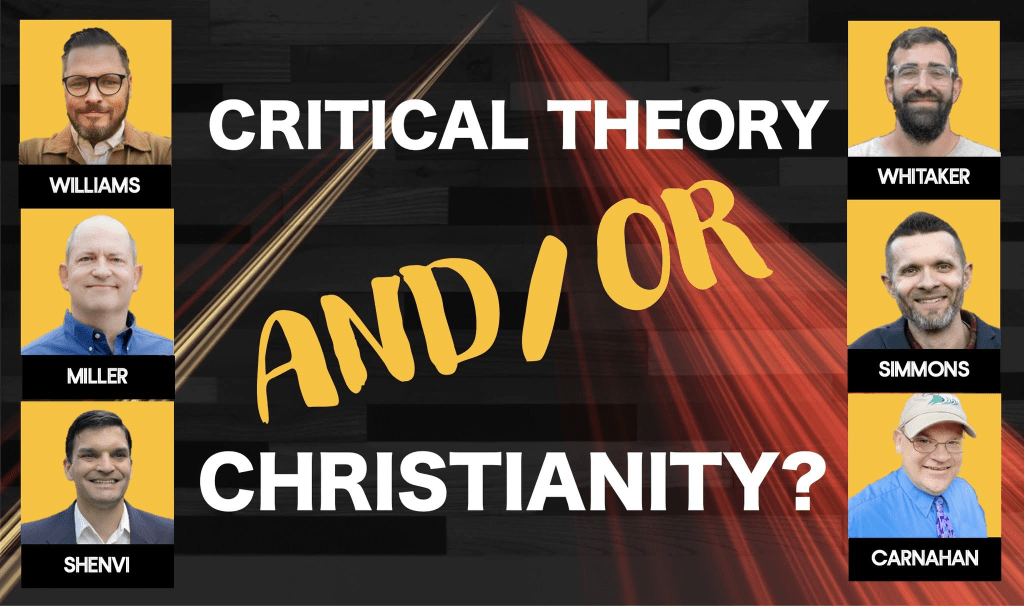
I recently had the opportunity to debate critical theory and postmodernism on Thaddeus Williams’ YouTube channel with Corey Millier, Tim Whitaker, Kevin Carnahan, and Aaron Simmons. The complete debate can be found here. Below are the notes for my opening statement.
In this brief opening statement, I’d like to do three things. First, I’ll define contemporary critical theory. Next, I’ll show that its methodology and assumptions will have devastating effects on basic Christian theology. Third, I’ll quote extensively from professing Christians, including Kevin himself, to show where critical theory will take you, theologically.
What is contemporary critical theory?
Contemporary critical theory is encapsulated in four main ideas:
1. Society is divided into oppressor and oppressed groups along lines of race, class, gender, sexuality, and religion.
2. Oppression takes place through ideology or what’s called “hegemonic power.” The ruling class, whether it’s Whites, men, heterosexuals, or Christians, imposes its values and norms on all of society in a way that seems “natural” and “common sense” and even “God-ordained.”
3. Oppressed people can see through these ideologies due to their lived experience. Therefore, privileged people should defer to their authority.
4. Social justice requires that we dismantle the systems and structures which perpetuate the ideology of the ruling class.
If people are skeptical that this summary of contemporary critical theory is accurate, I have quite literally thousands of words of quotes from primary sources which will support them and which I’d be happy to share.
Why is critical theory dangerous?
Next, I’ll focus on just one of many conflicts between Christianity and critical theory: its posture towards knowledge. Like postmodernism, critical theory is highly skeptical of objective truth claims, which it views as bids for power and privilege. So if a White Christian male says something like “salvation is through Christ alone” the critical theorist will respond, “You’re only saying that to justify your White, male, Christian privilege.” And if the White Christian male appeals to Scripture, the critical theorist will say, “That’s just you’re Eurocentric, rationalist, white male interpretation of Scripture.”
This approach to truth cannot be confined to one or two carefully-selected doctrines, but will cast suspicion on Christianity as a whole.
Critical theory applied to theology
If you’re skeptical that this concern is legitimate, let me offer a handful of real-life examples.
Dr. Christena Cleveland was a prominent figure within evangelicalism in the 2010s, platformed by CRU, intervarsity, Christianity Today, and Lifeway. Then, in 2019, she explained how critical race theory had taught her to see the world as an “oppressive ladder” with “straight white men at the top” and “trans black women” at the very bottom. In 2022, she wrote a book entitled God is a Black Woman. Here are some quotes from that book:
“more than anything, we must eradicate the transphobia within ourselves and our communities. For if God is a Black woman, then She’s a Black trans woman. Obviously.” (232)
“toxic masculinity’s idols of knowledge [are:] logic, reason, tradition, certainty, and consensus” (54)”
“As I continued my spiritual path toward the Sacred Black Feminine, I wanted to stop asking, ‘What can I prove? What is orthodox? What can be substantiated by history or scripture?’ Instead, I wanted to ask ‘what nurtures hope in my Black female embodied soul?…What liberates my Black female embodied soul?‘” (60)
Next, I’d like to quote from Marcella Althus-Reid, a queer theologian, in her book Indecent Theology. Kevin quotes her repeatedly and positively in his own book. If anyone is inclined to say that queer theology is unrelated to critical theory or postmodernism, she mentions Marx 32 times, Gramsci 12 times, and Foucault 8 times.
This is some of what she says:
“All theology is sexual theology…Theology is a sexual act and Indecent Theologians are called to be sexual performers of a committed praxis of social justice and transformation of the structures of economic and sexual oppression in their societies.” (i-ii)
“the New Testament starts with a quasi-woman (Mary, a de-biologised being) and her sexual intercourse with a God,” (12)
“It is interesting how an eternal God only had one registered case of pro-creative sex in history. We may assume that the rest of his lonely pleasurable activities were of a non-procreative nature.” (54)
“theology is a sexual action. Theologians, therefore, are nothing else but sexual performers” (87)
“Who subjugates women as [YHWH] does [in the Hebrew Scriptures]? Who undertakes sex and war in the name of destiny as does the God of Israel?… In the New Testament, the sexual harassment of a child, Mary, and the torture of Jesus are His main attributable actions. There is even certainty about YHWH’s preferences: He prefers young girls.” (108)
Incidentally, these quotes are exceptionally tame in comparison to others that I could share from this book.
Finally, let me quote Kevin himself from his book, The Disappearance of Eve and the Gender of Christ — Why Traditional Soteriology Requires a Trans* Savior. He writes:
“Paul (and many others) will make a hash out of the claim that both males and females are created in the image of God.” (31)
“Misogyny is clearly in play when part of Eve’s punishment consists of being ruled by her husband.” (41)
“As with all contexts, sex and gender are not “natural” in the sense that they exist from time immemorial or are immutable.” (191)
“queer theologians remind us, our job cannot simply be expanding the present order to include more people. It must also include the perpetual deconstruction of the present order.” (308)
To the overwhelming majority of Christians throughout history, these statements range from deeply erroneous to insanely blasphemous. Today, I’m going to demonstrate that they are all inescapable consequences of embracing contemporary critical theory. Critical theory’s skepticism towards objective truth claims is a universal acid. It’s possible to be self-reflective and thoughtful without embracing a hermeneutic of suspicion that will eat away the foundations of your faith. It’s contemporary critical theory or Christianity. You’re going to have to choose.
Related articles:

