
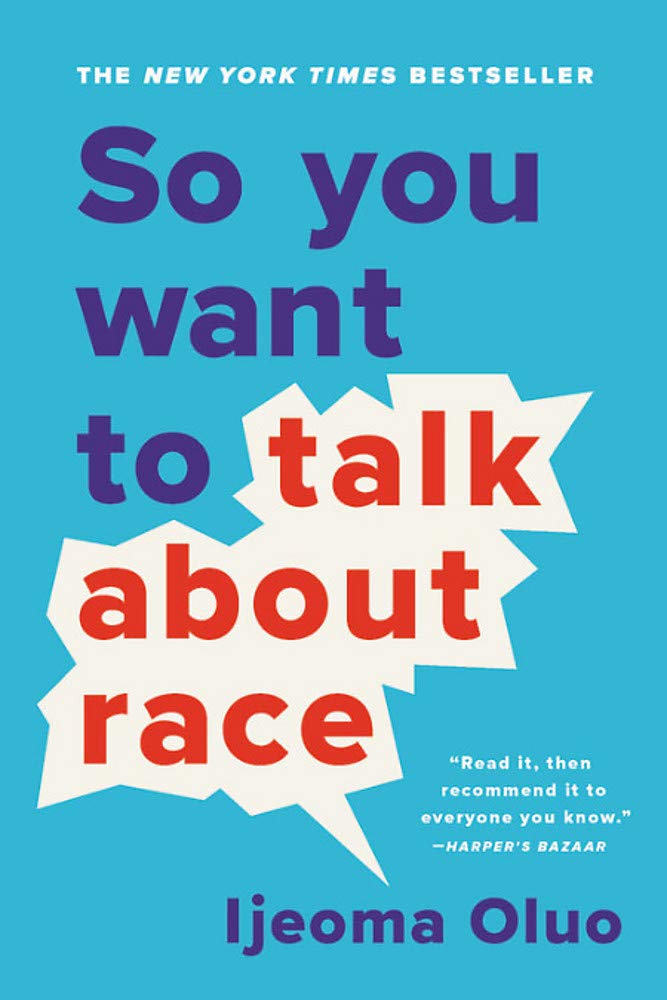
Ijeoma Oluo’s So You Want to Talk About Race is one of a growing number of books that communicates critical race theory to a popular audience. Critical race theory is a scholarly enterprise based on the assumption that racism is 1) normal, permanent, and pervasive, 2) concealed beneath claims of “objectivity,” “colorblindness,” and “neutrality,” 3) part of an interlocking system of oppressions and 4) best understood through lived experience. The most noteworthy aspect of the book is how clearly it illustrates “idea laundering,” the process by which lofty academic ideas filter into the popular consciousness through a succession of authors, making it difficult to recognize their origins. Consequently, readers come to think that critical race theory isn’t a particular ideology with a questionable set of assumptions but is just “the way sophisticated people talk about race.” Thus, the presuppositions and language of CRT come to be mainstreamed and accepted to the point that they are simply taken for granted.
By way of illustration, the “Notes” section of Oluo’s book contains only 37 references, the majority of which link to websites or news organizations (The Huffington Post, The Washington Post, CNN, and USA Today are all cited). Of course, there’s nothing wrong with citing popular sources. But in a book with entire chapters devoted to questions like “What is racism?” “What is intersectionality and why do I need it?” “What is cultural appropriation?” and “What are microaggressions?” it’s remarkable that Oluo cites so little scholarship. Certainly, she gives the reader no hint that any of these concepts are controversial.
Below, I’ll show how the ideas in her book perfectly parallel the core tenets of critical race theory.
Racism is Normal, Permanent, and Pervasive
Critical race theory assumes that racism is normal, permanent, and pervasive. That is, racism is deeply embedded in systems and structures and functions as an unremarkable and unnoticed feature of our everyday, normal life.
Oluo concurs.
“As a black woman, race has always been a prominent part of my life. I have never been able to escape the fact that I am a black woman in a white supremacist country.” (p. 1)
“There is real pain in our racially oppressive system, pain that I as a black woman feel.” (p. 6)
“If you are looking for a simple way to determine if something is about race, here are some basic rules…
- It is about race if a person of color thinks it is about race.
- It is about race if it disproportionately or differently affects people of color.
- It is about race if it fits into a broader pattern of events that disproportionately or differently affect people of color.
Now, looking at this short list, it’s easy to think–hey, that is far too broad, almost anything can fall under those categories! And it’s true, almost anything can fall under these categories. Why? Because race impacts almost every aspect of our lives.” (p. 15)
Racism Is One of Many Interlocking Systems of Oppression
CRT has always insisted that racism is merely one of many systems of oppression which also include sexism, classism, and heterosexism. Because these systems are intertwined, they must be dismantled simultaneously. Additionally, your intersectional “social location” as a member of various oppressed groups will shape your exprience of reality.
Listen to Oluo:
“it is never okay to battle racism with sexism, transphobia, ableism, or other oppressive language and actions. Don’t stoop to that level, and don’t allow others to. We must be willing to fight oppression in all of its forms.” (p. 47).
“Each of us has a myriad of identities —our gender, class, race, sexuality, and so much more— that inform our experiences in life and our interactions with the world… the different hierarchies, privileges, and oppressions assigned to these identities affect our lives in many ways.” (p. 75)
“if you are white in a white supremacist society, you are racist. If you are male in a patriarchy, you are sexist. If you are able-bodied, you are ableist. If you are anything above poverty in a capitalist society, you are classist. You can sometimes be all of these things at one.” (p. 216-217)
Lived Experience Is Crucial for Understanding Racism
All critical social theories aim to peer beneath claims of “objectivity,” “rationality,” and “common sense” to see how truth claims serve to perpetuate the oppressive status quo. But if objectivity is called into question, what’s the alternative? Lived experience. The lived experience of marginalized groups, such as people of color, women, and LGBTQ people, gives them better access to truths about social reality.
Oluo picks up on this theme:
“It is about race if a person of color thinks it’s about race. This may sound at first like I’m asking you to just take every person of color’s word for it, as if they are infallible… But the truth is, whether or not someone is fallible is beside the point. We are, each and every one of us, a collection of our lived experiences… And so, if a person of color says that something is about race, it is— because regardless of the details, regardless of whether or not you can connect the dots from the outside, their racial identity is a part of them, and it is interacting with the situation.” (p. 15)
“As a person of color… you have the right to call out each and every [microaggression] that you choose to. Do not let people convince you that you are being oversensitive, that you are being disruptive or divisive. What is harmful and divisive are these acts of aggression against people of color that are allowed to happen constantly, without consequence.” (p. 174)
To Whites who have been accused of racism, Oluo offers this advice:
Remember that you do not have all of the pieces. You are not living as a person of color. You will never fully understand the impact that sustained, systemic racism has on people of color. You will never be able to fully empathize with the pain your actions may have caused. Nothing will get you there. Do not discount someone’s complaint because their emotions seem foreign to you. (p. 220-221)
Summary
Fans of critical race theory sometimes insist that it is merely an esoteric academic discipline only taught in law schools. That simply isn’t the case. CRT scholars themselves will boast about its broad readership and profound influence outside the academy. Oluo’s book is an excellent example of how CRT’s assumptions have been onboarded by activists and large swaths of our culture.
See all content on critical theory here.
Related articles:
 Neil Shenvi - Apologetics