
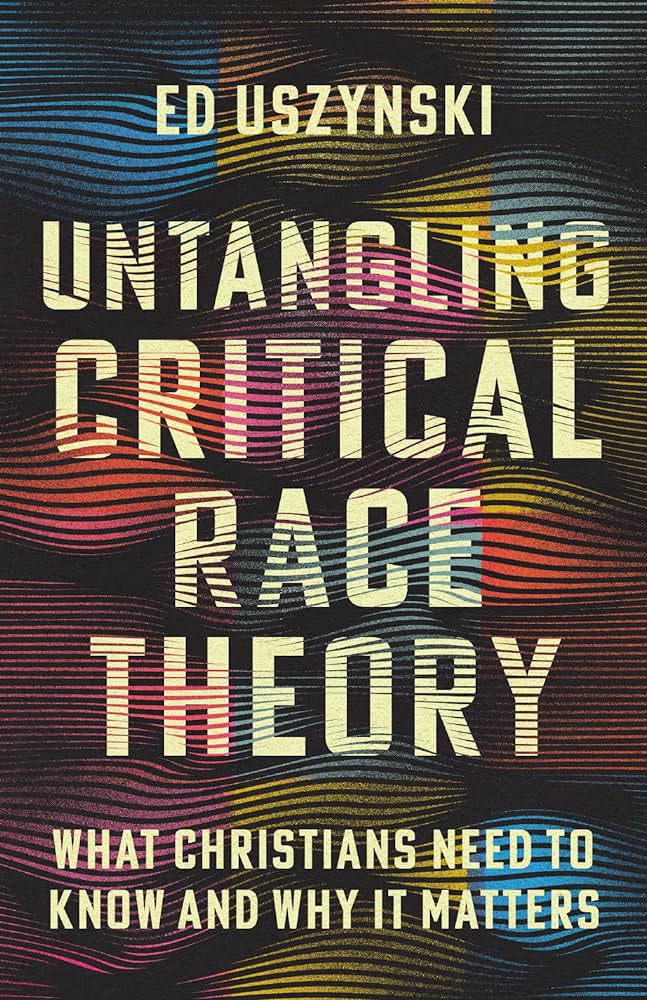
Dr. Ed Uszynski has a PhD in Cultural Studies from Bowling Green University and has worked with major evangelical organizations including CRU, Athletes in Action, Family Life, and Desiring God. Therefore, he is one of the few individuals who stands at the intersection (pun intended) of evangelicalism and critical race theory. His book Untangling Critical Race Theory is an attempt to turn the temperature down on the debate over critical theory, social justice, and Christianity. Unfortunately, his work is a frustrating mix of clarity and confusion.
Positives
There are many positive elements of Untangling CRT that every Christian should appreciate.
1. Uszynski is clearly motivated by a desire to see Christians pursue racial unity and biblical justice. He is correct that some (not all) conservative Christians throw around terms like “woke,” or “Marxist,” or “CRT” to label anything they dislike. For example, Uszynski recounts a discussion with a ministry colleague who demanded to know where the Bible says that we should “give special attention to vulnerable or poor and marginalized populations” (p. 150). Given the dozens (hundreds?) of Scripture verses commending concern for the poor, this is an astonishing request. As Christians, we cannot let our rejection of “wokeness” cause us to run headlong into opposite errors.
2. The book gives a helpful, accurate, and forthright description of the relationship between Marxism, Critical Theory, and critical race theory: “CRT depends on CT, and CT grew out of Marxism” (15). Uszynski describes how Marx’s atheistic, materialistic view of history lies at the heart of his ideology and how later critical theorists applied his ideas to social structures in general. Chapter 4 concludes with this helpful analogy: “If Marx built the house, and Critical Theory modernized and refurbished the rooms, then Critical Race Theory added a new wing with its own uniquely stylized decor” (p. 79).
3. Uszynski realizes that the atheistic assumptions of Critical Theory and the expansive interests of modern critical theorists can indeed lead to incompatibilities with Christianity: “[Christianity and Critical Theory are] not asking to be reconciled. A body of belief that starts by asserting that there is no God is fundamentally at odds with one that believes God exists and has literally spoken in time” (p. 60). He even repeatedly affirms that critical theory can function as a worldview, one that is fundamentally incompatible with Christianity: “because [Critical Theories] exist as an extension of Marxism, they can also be combined to form a worldview… While arguing for the observatory value of individual [critical] theories, absorbing the collective ethos of Critical Theory as a way of life is ultimately destructive” (p. 67) and “It’s not difficult to see where Christianity and Critical Theory conflict… When CT is addressed as a comprehensive worldview, [decrying CT’s incongruity with Christianity] makes sense” (p. 68).
4. Untangling CRT recognizes that racial disparities have many causes and cannot always be attributed to racism. When CRTs state that systemic racism produces racial disparities, Uszynski insists that they “aren’t saying racism is to blame for every manifestation of group advantage or disadvantage. Choices play a role. Class discrimination plays a role. Family structure plays a role. And race plays a role.” (p. 99)
5. In the chapter “Redeeming ‘Social Justice’ From Injustice,” one of Uszynski’s admonitions to Christians is to “separate the conversation around racial injustice from claims of gender or sexuality oppression–they are not the same thing. Critical Social Justice says all three must be considered together, but we don’t have to accept that packaging” (p. 212). This point is tremendously important, and Uszynski repeats it throughout the book.
6. Because critical theory has been heavily influenced by postmodernism and attempts to “see through” truth claims as bids for power, it can be deeply corrosive to Christian doctrinal commitments. Uszynski rejects this posture and asserts that the Bible is God’s objective revelation to humanity.
7. Uszynski correctly notes that critical race theorists occasionally offer true insights that Christians can and should affirm. For example, critical race theorists are 100% right in their affirmation that “race is a social construct” and generally have a clear-eyed view of how skin-color came to be imbued with a particular social and legal meaning in the United States.
8. Uszynski explicitly rejects numerous “woke” ideas like “BIPOC voices are always more important than white voices [or that] a nonwhite recounting of an experience always reflects an accurate rendering of what happened” (p. 100), or “[we should reject] the importance of hard work altogether” (p. 101), or “white people are evil all the time and never to be trusted under any circumstances” (p. 106).
Despite these (and other) points of agreement that I have with the book, I believe its central thesis is false. Uszynski’s argues that “Genuine CRT concepts aren’t antithetical to a Christian worldview” (p. 81) and therefore that evangelical concern over CRT is unwarranted. This is incorrect. In what follows, I’ll point out the various ways in which Uszynski either downplays or overlooks the dangers of critical race theory.
Negatives
Faulty representations of CRT
First, Untangling Critical Race Theory contains very few lengthy quotes from primary sources on CRT. This approach certainly makes the book more accessible, but it means that the reader is one degree removed from the academic literature. While this complaint may seem like nit-picking, it leads to my first major criticism: Uszynski’s gloss on CRT doesn’t always cohere well with the actual literature he cites.
One very important case involves his explanation of “intersectionality” in chapter 6. Uszynski writes that intersectionality is the idea that “a person can experience different forms of discrimination depending on the various social identities they wear in a specific context” (p. 108). He offers the example of an elderly Black woman whose age, race, and gender all shape how she is perceived and treated. He comments that when he first encountered this idea he remembers “thinking nothing could be more obvious” (p. 108) and that’s correct. People like conservative pundit Ben Shapiro or social psychologist Jonathan Haidt recognize that this narrow understanding of “intersectionality” is just common sense.
However, when we read what CRTs actually say about “intersectionality,” it’s doubtful that they have such a narrow definition in mind. Critical race theorist Kimberlé Crenshaw introduced the term “intersectionality” in two seminal papers in 1989 and 1991, both of which Uszynski cites. Yet listen to this illustration from her 1989 paper:
“the following analogy can be useful in describing how Black women are marginalized in the interface between antidiscrimination law and race and gender hierarchies: Imagine a basement which contains all people who are disadvantaged on the basis of race, sex, class, sexual preference, age and/or physical ability. These people are stacked-feet standing on shoulders-with those on the bottom being disadvantaged by the full array of factors, up to the very top, where the heads of all those disadvantaged by a singular factor brush up against the ceiling.”
Or consider this passage from footnote 9 of her 1991 paper:
“In mapping the intersections of race and gender, the concept does engage dominant assumptions that race and gender are essentially separate categories. By tracing the categories to their intersections, I hope to suggest a methodology that will ultimately disrupt the tendencies see race and gender as exclusive or separable. While the primary intersections that I explore here are between race and gender, the concept can and should be expanded by factoring in issues such class, sexual orientation, age, and color.“
Three points stand out in these passages (points that are repeated throughout the entirety of these two papers). First, Crenshaw does not invoke “intersectionality” to merely claim that everyone’s identity is complex. Rather, she is claiming that identities are part of a hierarchy with rich young straight White men at the top and poor elderly LGBTQ Black women at the bottom. Second, the entire purpose of Crenshaw’s concept of intersectionality is to reject the idea that racism and sexism and other oppressions can be separated. Third, she explicitly mentions sexuality in both papers as an identify factor that “can and should” be treated on the same footing as race and gender.
Given these three points, we immediately run into a problem: Uszynski correctly insists that Christians must decouple race from sexuality to preserve their commitment to biblical sexual ethics. But CRT explicitly rejects this decoupling! Moreover, the belief that race, class, gender, and sexuality all constitute “interlocking systems of oppression” is not unique to Crenshaw. It is routinely listed as one of the core tenets of CRT.
For example, Uszynski himself cites the 1993 anthology Words that Wound, which was edited by four cofounders of CRT including Crenshaw. Yet the authors list the sixth “defining element” of CRT as follows:
6. Critical race theory works toward the end of eliminating racial oppression as part of the broader goal of ending all forms of oppression. Racial oppression is experienced by many in tandem with oppressions on grounds of gender, class, or sexual orientation. Critical race theory measures progress by a yardstick that looks to fundamental social transformation. The interests of all people of color necessarily require not just adjustments within the established hierarchies, but a challenge to hierarchy itself.
In other words, if Christians insist on “decoupling” race from sexuality, we can only do so by rejecting one of the defining elements of CRT.
A second example of the conflict between Uszynski’s interpretation of CRT and the actual writings of its advocates involves CRT’s skepticism toward meritocracy and objectivity. Uszynski consistently argues that accepting CRT does not entail acquiescing to some form of postmodern relativism. On page 103, Uszynski assures readers that the claim that “objective facts don’t exist at all” is a “misuse” and a “distortion” of CRT. But is that really the case?
Consider the following quote from Delgado and Stefancic’s book CRT: An Introduction (which Uszynski also cites):
“for the critical race theorist, objective truth, like merit, does not exist, at least in social science and politics. In these realms, truth is a social construct created to suit the purposes of the dominant group” (p. 104, 2nd ed.)
Or consider UC-Berkeley law professor Khiara Bridges in her book CRT: A Primer. She writes:
“CRT is simply skeptical that a ‘neutral’ standard, an ‘objective’ rule, or a ‘rational’ regime exists. Neutrality, objectivity, and rationality are supposed to be outside of power. But, CRT proposes that power –white racial power, to be precise– created these concepts…The result is that CRT tends to understand ‘neutrality’, ‘objectivity,’ and ‘reason,’ to be traps. They are excuses for maintaining the current maldistribution of racial power” (p. 49)
In these cases and others, what Uszynski labels a “misuse” of CRT is actually an intended use. Therefore, Uszynski’s claim here is illegitimate. In precisely the same way, it would be illegitimate to tell a classical Marxist who argued for the abolition of private property that he was “misusing” or “distorting” Marxism or to tell a Muslim that he was “misusing” or “distorting” the Qur’an to argue that Jesus was merely a human prophet.
The final section of Chapter 6 is entitled “CRT On Its Own Terms” and –ironically– this is precisely where Uszynski struggles. In his desire to make the ideas of CRT more palatable to Christians, he ends up obscuring what CRTs actually believe.
CRT and the Progressive Worldview
As I mentioned in the first section, Uszynski rightly recognizes that there is a Progressive worldview that is incompatible with Christianity. Yet he also believes that CRT is compatible with Christianity. He can hold both beliefs because he draws a sharp distinction “between CRT as an academic discipline and CRT as a… radicalized (Progressive) political saber” (p. 81).
For instance, he makes statements like:
“both conservatives and progressives politically co-opt the letters CRT, stretching and weaponizing the original ideas toward extremes that go beyond what many of the original authors had in mind” (p. 87)
and
“capital-P Progressive is a philosophy of life, a political movement with a particular vision whose values run contrary to most of the Christian worldview. These folks tend to be titillated by the idea of revolution, questioning everything ever produced by white, male, capitalist heterosexuals” (p. 116)
However, the hermetic barrier he erects between CRT and Critical-Theory-As-Progressive-Worldview is impossible to maintain for several reasons.
Most importantly, the very concept of intersectionality (which –recall– is a “defining element” of CRT) rejects such a compartmentalization. CRT does not allow us to only think about racial oppression. It insists that racial oppression is inextricably intertwined with gender oppression, heterosexism, classism, ableism and a whole host of other social structures and systems which must be dismantled. To borrow Uszynski’s metaphor, if CRT is a new wing in the house that Marx built, then intersectionality has knocked down all of the house’s interior walls in pursuit of an “open concept” floor plan.
Moreover, the implications of CRT’s central tenets are far broader than Uszynski implies. CRT affirms the oppressor/oppressed social binary. Its skepticism towards “objectivity” and “neutrality” and its valorization of “experiential knowledge” is rooted in the Marxist conception of “false consciousness” and feminist “standpoint epistemology.” It rejects the idea that human law should be rooted in natural law or divine law. It interprets of our daily experiences in terms of “whiteness,” “privilege,” and “systemic oppression.” It promotes specific views on justice and equity. And it has a particular telos or purpose — liberation. (If you’re skeptical about my summary here, please read my article What Is Critical Race Theory? which contains thousands of words of verbatim quotes from primary sources with zero commentary). Even if we eschew the specific term “worldview,” it seems highly improper to treat CRT as no more than a narrow analytic tool.
Finally, the idea that we can separate CRT from “Progressive politics” would come as quite a shock to critical race theorists, who have always insisted that their theories were meant to further their liberatory political goals. For example, Section III of Crenshaw’s 1989 paper is entitled “When and Where I Enter: Integrating an Analysis of Sexism into Black Liberation Politics” and Section IV is entitled “Expanding Feminist Theory and Antiracist Politics by Embracing the Intersection.”
Praxis (or sociopolitical application and activism) has always been a crucial component of critical theory, in all its forms. As Uszynski himself says: “‘Critical’ implies a desire to change society, not just interpret it” (p. 55) and “CRT is fundamentally political, concerned with practical change on behalf of people significantly influenced by those policies and patterns” (p. 112). Thus, it is extremely puzzling to find him later saying that “Theory doesn’t prescribe solutions. Theory analyzes. People motivated by political ideology recommend solutions. Politics tries to fix what theory exposes” (p. 115). This latter claim is true of “traditional theory” but it is absolutely untrue of “critical theory,” which –by definition– aims to fix society, not merely to analyze it.
The upshot is that the “radical Progressive package” which Uszynski rejects is a logical, natural, and ideological entailment of critical race theory. Critical race theorist Khiara Bridges is helpful here. She names the following as an “essential tenet” of CRT:
“scholarship is not, cannot, and should not be disconnected from people’s lives on the ground. Thinkers using a CRT framework produce their scholarship with the hope of dismantling systems that subordinate people of color. CRT believes that all knowledge is political. It believes that scholarship that ignores race is not demonstrating ‘objectivity’ or ‘neutrality,’ but rather is demonstrating its own political commitments to the existing racial order” (p. 13)
Claiming that we can sever the ideas of critical race theory from its political expression is bit like claiming that we can sever the doctrines of Christianity from their ethical outworking. A critical race theorist who saw us co-opting the ideas of CRT while hemming and hawing over actually applying them politically on behalf of “massive social transformation” would be justified in telling us “faith without works is dead.”
Cautionary Tales
Finally, as I mentioned, Uszynski is correct that fears over CRT can be used to shut down all discussion of race. However, given his desire to pursue healthy racial dialogue, he makes some odd choices when it comes to the Christian authors he chooses to highlight.
For example, he opens Chapter 9 by describing a controversial talk given by Be The Bridge founder Latasha Morrison to “five thousand CRU ministers at [their] biennial training conference” (p. 140). Although he (obviously) doesn’t post the talk in full, he believes that each individual’s reaction was not determined by the talk’s content but by “their reckoning and interaction with categories” like “restorative justice” and “the oppressed” (p. 142).
Yet is it possible that some participants were also uncomfortable with Morrison’s ministry and overall perspective on race? For instance, in 2020, Be The Bridge posted an official position paper on CRT, saying that while it rejects CRT as a “guiding framework” it affirms that terms like “white privilege,” “white fragility,” and “colorblind racism” are “useful where they come alongside the mission, vision, and values of BTB and are helpful in understanding and addressing issues in our institutions, communities, and nations in the 21st century.” What does Be The Bridge’s affirmation of CRT look like “on the ground?”
In 2019, Be The Bridge printed a list of 16 Bridge Building Tips for White People” that included the following items:
“2. Don’t take up too much (metaphorical) space in the conversation…Take this opportunity to sit quietly and elevate the voices of POC…
4. Don’t ‘Whitesplain.’ Do not explain racism to a POC. Do not explain how the microaggression they just experienced was actually just someone being nice. Do not explain how a particular injustice is more about class than race…
7. Don’t explain away a POC’s experience of oppression…Take their word for it…
9. Don’t demand proof of a POC’s lived experience or try to counter their narrative with the experience of another person of color…
11. Do not chastise POC (or dismiss their message) because they express their grief, fear, or anger in ways you deem ‘inappropriate.’… Provide space for POC to wail, cuss, or even yell at you…
15. Don’t get defensive when you are called out for any of the above. When a person of color tells you that your words/tone/behavior are racist/oppressive/triggering, you stop. Don’t try to explain yourself (see #6)…”
Does this advice, given to White people specifically and not to POC, qualify as healthy Christian engagement with CRT?
Uszyksni opens chapter 12 “Responding to Concerns About CRT” with an unobjectionable quote from David W. Swanson’s book Rediscipling the White Church. But Swanson’s book also contains statements like this one:
“We [Whites] are a damaged people. In the past, most of us have ignored the hidden wound, the result of our devilish bargain for controlling power. We don’t think of ourselves as privileged, as having been given a leg up at someone else’s expense. But if we will be still long enough, we might begin to sense the damage we carry, the damage with which we are complicit, the damage we’ve inflicted. And if we choose to trust the voices and experiences of people of color, our capacity to feel this damage will grow, and with it, our ability to challenge the destructive demands of whiteness” (p. 49-50).
Later, Uszynski quotes Andrew T. Draper’s essay “The End of ‘Mission’: Christian Witness and the Decentering of White identity,” in Love Sechrest’s anthology Can ‘White’ People Be Saved? Draper writes that the study of “whiteness” is the study of “an idolatrous system of embedded norms intricately arranged to prefer, esteem, and profit white people by any means necessary” (p. 226). In context, Uszynski clearly agrees with this quote.
And in that same essay, Draper writes things like:
“whiteness is best understood as a religious system of pagan idol worship” (p. 177).
And “As idolatry, whiteness must be dealt with like any such cultic system: its high places must be torn down and its altars laid low” (p. 178).
And “If… whiteness is a way of life into which its novitiates are discipled, then a Christian discipleship that entails a deconversion from whiteness is necessary if any true experience of reconciliation with God, others, the creation, and ourselves is to take place. (p. 181)
Next, Uszynski quotes a passage from Austin Channing Brown’s book I’m Still Here, where she talks about the need for curiosity and openness in racial dialogue. So far, so good. But once again, Brown’s book contains many other dubious quotes. Her first chapter is entitled “White People are Exhausting” (p. 11) and she makes claims like these throughout the book:
“Whiteness constantly polices the expressions of Blackness allowed within its walls” (p. 70).
“Whiteness likes a trickle of Blackness, but only that which can be controlled” (p. 71).
“Whiteness wants us [Blacks] to be empty, malleable, so that it can shape Blackness into whatever is necessary for the white organization’s own success” (p. 79).
“The white Church considers power its birthright rather than its curse” (p. 167).
Brown even describes a trip that an interracial group of middle-school students took to a plantation. After the tour, she recounts how a Black senior stood up and said: “I think I’ve just been convinced that white people are innately evil. You can’t help it. You steal and kill, you enslave and lynch. You are just evil.”
Brown’s commentary on the incident is: “The white students hadn’t appreciated her words, but the Black students could have kissed her feet… she had spoken her truth” (p. 57).
Now obviously (obviously!) an author can include a good quote from a book that he otherwise strongly disagrees with. Therefore, I am not arguing that Uszynski agrees with all the statements I just presented. However, it’s difficult to fathom how Uszynski can insist that evangelicals are exaggerating the dangers of CRT while simultaneously citing authors and books that demonstrate precisely those dangers!
Also, if I’m honest, it’s not entirely clear that Uszynski would disagree with all these other statements. For example, he explicitly says that critical race theory’s understanding of “whiteness” is correct while denying that “whiteness” makes someone an oppressor: “Properly understood as a colonialist, idolatrous mindset, whiteness is a moral blight, but none of this necessitates ‘malign(ing) all members of that racial group as complicit in oppression.'” (p. 233).
Or, when he shares his idea of writing a book on race with an African American friend, Uszynski tells the following story:
“[My friend James] scoffed ‘White people don’t want to hear any of that. They don’t want to think about race…’ He went on to say, without a hint of hyperbole, that white supremacy has become neurological for white folks. It’s so seared into our psyche that a literal rewiring of our brains would have to take place for us to view black folks differently.” (p. 219)
Again, it’s not clear exactly what we’re meant to take away from this anecdote. Does Uszynski also think that White people’s brains have been physically altered by white supremacy? Does he think James’ views are wrong but understandable? I honestly don’t know. But those of us who do see CRT as dangerously corrosive to the church’s theology and unity will see all these passages not as examples of CRT’s deep insights but as harrowing cautionary tales.
Summary
Uszynski’s Untangling Critical Race Theory does some things well and other things poorly. Uszynski himself is an evangelical with conservative theology, who cares deeply about racial unity, offers an accurate treatment of the history of Critical Theory and critical race theory, recognizes the incompatibility of the “Progressive worldview” and Christianity, and explicitly rejects many popular manifestations of wokeness. For these reasons, if you want to read an evangelical book that offers the best, most sympathetic take possible on CRT, then I’d recommend this one.
On the other hand, Uszynski fails to articulate how the core tenets of CRT are understood and expressed by actual critical race theorists and doesn’t appreciate how its core tenets cohere to provide a comprehensive view of social reality. He doesn’t believe that the porous boundaries between critical race theory and its ideological cousins like Queer Theory, postcolonial theory, and critical pedagogy will cause serious problems for Christians. And, finally, he doesn’t see how some of the most toxic elements of CRT –its skepticism towards objective truth, its racial identitarianism, and its rejection of biblical sexual ethics– are present in the very authors he lifts up as models of Christian engagement with the ideas of CRT.
In the end, Untangling Critical Race Theory does not live up to its title. It certainly contains positive elements, but it may leave readers with a false sense of security that they have “seen through” the “evangelical hysteria” over CRT and can embrace its concepts with confidence. For those of us who see CRT as an obstacle rather than an aid to racial unity, this possibility is disheartening.
 Neil Shenvi - Apologetics