
The term “woke right” is increasingly used by evangelicals who are broadly critical of “Christian nationalism” (there’s another loaded term!). But what is the “woke right”? Is it just a pejorative? Or does it accurately describe a movement with a particular set of beliefs? In this article, I’ll discuss 1) the origins of the term, 2) the question of whether a discernable “woke right” exists, and 3) some of the legitimate topics raised by the “woke right.” Finally, I’ll close by enumerating the serious problems with the “woke right.” My claim is that Christians should reject the ideology of the “woke right” for precisely the same reasons that we rightly reject the ideology of the “woke left.”
I. Where did this phrase come from?
The phrase “woke right” has been around for several years. In a 2022 interview, U.S. representative Dan Crenshaw (R) criticized the “woke right,” which he described as a mostly “online phenomenon.” According to Crenshaw, people on the woke right portray themselves as victims, immediately label anyone who disagrees with them as “establishment” or “globalist,” and “resemble the far left more than anything.” More recently, secular cultural commentators like Konstantin Kisin have likewise criticized the “woke right” for its knee-jerk contrarianism and have argued that the “Dissident Right” is “going woke.”
However, the use of the phrase “woke right” in evangelical circles seems to have begun in Nov. 2022 with Kevin DeYoung’s review of Stephen Wolfe’s book The Case for Christian Nationalism. His article was entitled “The Rise of Right-Wing Wokeism” and I’ll quote three relevant paragraphs in full:
Besides trafficking in sweeping and unsubstantiated claims about the totalizing control of the Globalist American Empire and the gynocracy, Wolfe’s apocalyptic vision—for all of its vitriol toward the secular elites—borrows liberally from the playbook of the left. He not only redefines the nature of oppression as psychological oppression (making it easier to justify extreme measures and harder to argue things aren’t as bad as they seem), he also rallies the troops (figuratively, but perhaps also literally?) by reminding them they’re victims. “The world is out to get you, and people out there hate you” is not a message that will ultimately help white men or any other group that considers themselves oppressed.
When Wolfe sarcastically thanks those who “woke many from their dogmatic slumber” and rejoices that “more are awakening each day,” one might be forgiven for seeing his version of Christian Nationalism as a form of right-wing wokeism. What does it mean to be woke if not that we’re awakened to the “reality” that oppression is everywhere, extreme measures are necessary, and the regime must be overthrown?
If critical race theory teaches that America has failed, that the existing order is irredeemable, that Western liberalism was a mistake from the beginning, that the current system is rigged against our tribe, and that we ought to make ethnic consciousness more important—it seems to me that Wolfe’s project is the right-wing version of these same impulses.
Another important use of the phrase “woke right” came from Doug Wilson in an interview with Sean DeMars and Joe Rigney. Here is the relevant portion of that interview:
Demars: Do you believe in the “woke right”?
Rigney: Like basically the equivalent of the woke left but the Dissident Right guys…
Wilson: This is something I’m actually quite concerned about [–] identity politics on the right…these are people who’ve been taunted their entire adult lives for being White. And finally they say “I might as well be proud of it…I’m going to be White and proud and start hating Jews.” That is a big concern of mine… On the anti-Semitism which is starting to manifest itself on the Right: I’ve been fighting that tooth and nail. And a lot of people on the Right have responded with ‘Ok Boomer’
This excerpt is particularly relevant because Wilson is one of the few major evangelical theologians who is generally supportive of Christian nationalism (for example, he published the Wolfe book that was the subject of DeYoung’s review).
Finally, in 2020, I (descriptively, not pejoratively) defined left-wing wokeness as follows:
1) society is divided into oppressed/oppressor groups along lines of race, class, gender, sexuality, etc via 2) hegemonic power. But privileged people are blind so 3) we need to defer to the lived experience of the marginalized to 4) dismantle unjust systems.
A few months ago, I argued that the ideology of the “Dissident Right” could be defined in precisely analogous terms:
1) society is divided into straight White men and their enemies via 2) hegemonic norms (“the Longhouse,” “postwar consensus,” “Judeo-Christianity”) but normies are blind so 3) we need to redpill them to 4) retake the West.
The characterizations independently offered by DeYoung, Wilson, and myself are strikingly similar.
II. Problems with the label “woke right”
Critics of the term “woke right” can offer several objections to the label itself.
First, they could argue that it is solely pejorative. Since most evangelicals rightly reject “wokeness,” the term “woke right” can be cast as nothing more than a lazy slur meant to scare Christians away from unorthodox political opinions.
Second, they could argue that “wokeness” is fundamentally a left-wing phenomenon. Therefore, by definition, there can be no such thing as the “woke right.”
Finally, they could argue that the “woke right” is a nebulous collection of groups with very different commitments and worldviews. It includes evangelicals, Catholic integralists, neo-Pagans, and Nietzschean vitalists. In other words, it doesn’t characterize a single ideology.
My response would be as follows:
First, while “woke right” certainly can be used as a lazy slur, it doesn’t have to be. In the same way, I have always used the term “woke” descriptively to refer to a particular set of ideas.
Second, if the term “woke” refers to a particular set of ideas, then insofar as these ideas have been adopted by some on the right, it seems perfectly reasonable to talk about the “woke right.”
Finally (and ironically!), I faced exactly these same objections when I talked about the “woke left.” I was accused of using a lazy slur. I was told that I was unfairly labelling people as “woke” simply for talking about justice. I was told that “wokeness” was being promoted by evangelicals, Catholics, progressive activists, and Neo-atheists and therefore didn’t characterize a single ideology. But those claims were, and are, incorrect. It turns out that “wokeness” is a real ideology that is exhibited by people with a variety of different worldviews, although wokeness does tend, in the end, to cannibalize those views.
For these reasons, I do think the term “woke right” is reasonable, provided the ideas of the “woke right” are sufficiently similar to those of the “woke left.”
But are they? To answer that question, I’d like to turn to some prominent examples of right-wing wokeness from the last few years.
III. Examples of the “Woke Right”
The first example comes from Stephen Wolfe’s cohost on the Ars Politica podcast. In 2021, he published an article under a pseudonym at the website Identity Dixie. In it, he commends an approach he calls “White AntiFragility.” He argues that White people need to explicitly embrace the ideas promoted by critical race educator Robin DiAngelo in her book White Fragility. He writes:
When White AntiFragility is confronted with critical race theory, it wouldn’t merely not cry or break down, nor would it merely maintain composure. Rather, it would use CRT’s own premises as resources for growth.…For instance, CRT teaches that Whites are guilty of their White ancestors’ sins…White AntiFragility, using the Counter Dilemma, neither concedes the point nor argues against it. Rather, it deduces another, positive conclusion from the same premises: If your White skin and genes confer the guilt of your ancestors, then they also confer the pride of your ancestors, as well as, their accomplishments, victories, virtues, rights, liberties, freedoms, heritages, lands, and more. Further, if skin and genes confer guilt then this implies that race and blood, kinship and ethnicity bind people together in real, social, national ways that cannot be broken by time or circumstance. CRT, by accusing Whites of racial guilt, reinforces and strengthens ethnic bonds between our ancestors, ourselves, and our posterity.
He also writes that:
“feminists and other deconstructionists [have done] another great service to us [Whites] by digging up and republishing the buried writings of our White, European ancestors.”
He continues:
They do this in order to expose, critique, and deconstruct the evils of our past – patriarchy, nationalism, racialism, and the like. But, White Antifragility observes that these babblers and zealots are merely digging up the gems of our ancestors for us and placing them on platters before our eyes.
He concludes his article by saying:
“When we become racially antifragile, we are freed to take our opponents’ weapons and grow stronger by them. We are no longer afraid of the accusations and rhetoric used against us. We take what they mean for evil and use it for good. We plunder the pagan Egyptians.
I can’t fathom reading this article and not recognizing it as the perfect, mirror image of left-wing wokeness. The author wants Whites to affirm the premises of CRT, but merely wants them to draw a different conclusion, one that strengthens Whites’ racial identity and makes them proud of it rather than ashamed of it.
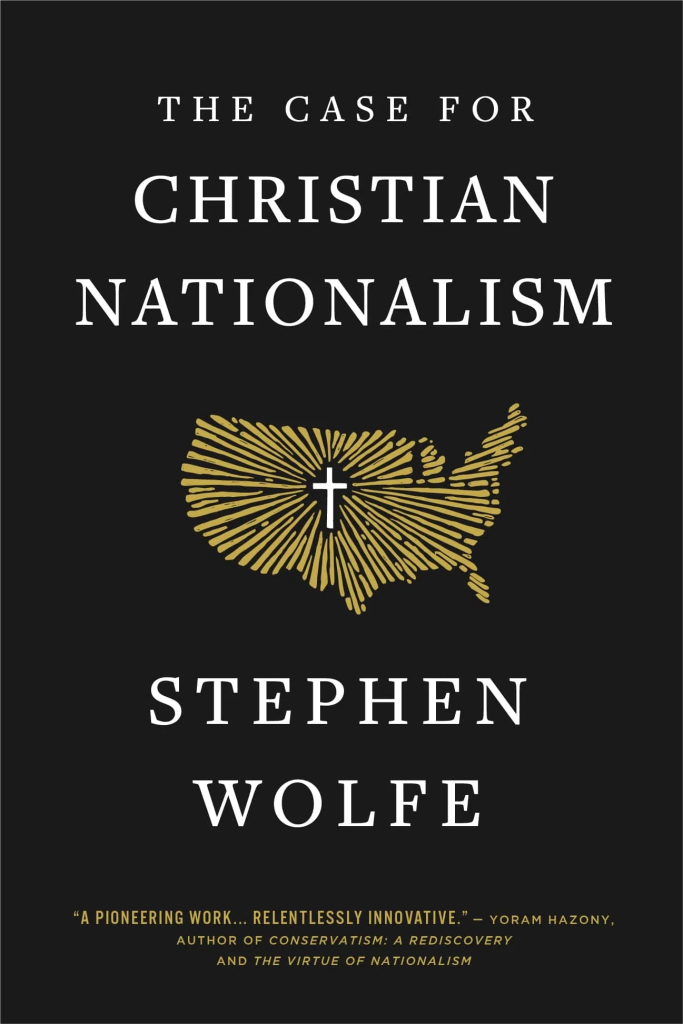
Next, let me offer a few quotes from Wolfe’s book The Case for Christian Nationalism, all of which were highlighted by DeYoung:
Every step of progress is overcoming you. Ask yourself, “What sort of villain does each event of progress have in common?” The straight white male. That is the chief out-group of New America, the embodiment of regression and oppression. (p. 436)
We live under a gynocracy—a rule by women. This may not be apparent on the surface, since men still run many things. But the governing virtues of America are feminine vices, associated with certain feminine virtues, such as empathy, fairness, and equality. (p. 448)
There is no robust common ground here. There is no credibility we can establish with them. Unavoidably, we are threats to their regime. Christian nationalism is an existential threat to the secularist regime. They are enemies of the church and, as such, enemies of the human race. (p. 456)
If you are a white, heterosexual, cis-gendered male, then the world will not offer you any favors. Indeed, your career advancement depends on sacrificing your self-respect by praising and pandering to your inferiors who rule over you. (p. 464)
Here we see straight White men positioned as a victim group in a society dominated by hegemonic narratives like the gynocracy. Straight White men need to wake up to this reality and fight back.
Lest there be any uncertainty that Wolfe embraces a “critical” analysis of society, he has said so explicitly in his Tweets
For example, he wrote:
“Anti-woke Christians, in their rejection of “power hierarchies” and “privilege,” have rendered themselves incapable of seeing the absurd but real privileges and power hierarchy at work in our world. This is why I will not reject a “critical” approach to social phenomena. There are subtle hierarchies of power, some natural and proper, and others artificial and absurd.” –
and
I fully admit that if being a “conservative” requires one to reject a “critical” approach to social phenomena, then I’m not a conservative. We live in liberal hegemony, and [Twitter user @Wokal_Distance] reflects precisely its commitments and power structures. –
and
“Our social world runs on subtle power relations. The problem with the left is they call them all arbitrary and unjust, based on an egalitarian principle (which the anti-woke largely share). –

Here’s a third example from the book The Boniface Option by Andrew Isker. Isker is the co-author with Andrew Torba of Christian Nationalism: A Biblical Guide for Taking Dominion and Discipling Nations. In his preface, Isker writes this:
“You live in a dystopia. Every part of historical human existence in our world has been turned on its head…The insane, dystopian and totalitarian world we fear the elites might create is one we already live in…I use the term Trashworld to describe the dystopian society. And the point of The Boniface Option is to make you see it for what it is and to begin the hard work of escaping and overcoming it” (p. ix-xi).
“the globohomo cinematic universe that the modern bugman lives in must be chopped down. All of it is a seamless garment. Trannies, open borders, acceptance and promotion of sodomy and other sexual perversions, feminism, abortion and antinatalism, anti-white race hate (so-called Critical Race Theory), pornography and the entire consumerist lifestyle… must be sent through a woodchipper” (p. 18).
“We believe because modern, liberal, egalitarian society abolished the formal institutions of slavery that slavery qua slavery has been eradicated. But it very clearly has not. Instead, it is wrapped in a thin veneer of consent. If you were a wicked, evil social engineer and were going to design a massive slave state, the very best conditions would be where the masses believed they were totally free and that their own bondage was their choice” (p. 74).
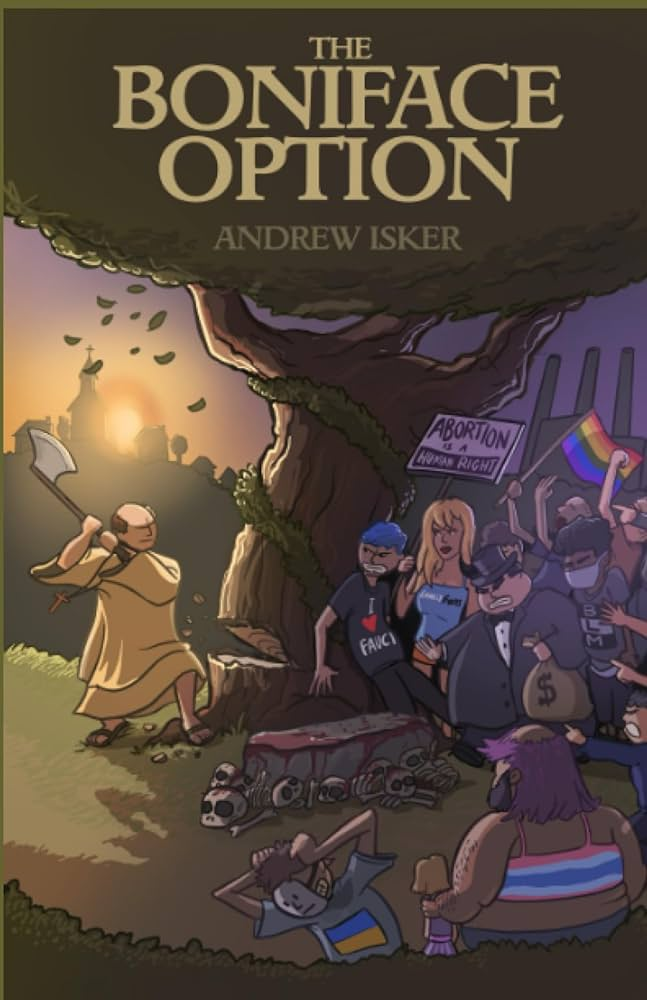
Note the frequent allusions both to oppressive hegemonic ideologies like liberalism, egalitarianism, and feminism and to the blindness of “normies.” His framework is classic Neo-Marxism, albeit from someone on the Right: the proletariat (straight White male normies) are blind and consent to their own oppression due to the hegemonic power of the bourgeoisie (the bugmen overlords of Trashworld).
Finally, C.J. Engel is Andrew Isker’s podcast co-host and a frequent advocate for people he calls “Heritage Americans.” Recently, he defined this term in a long Twitter post. I can’t quote it in full, but he wrote:
“When I say Heritage American, this is what I mean: those who are ethno-culturally tied to the ethos and spirit of the United States prior to its definitional transformation into a Propositional Nation after World War II. This therefore includes the type of people that came here during the Ellis Island generation, even if that was a significant sociopolitical mistake…. It includes the blacks of the Old South (like Booker T Washington), though it repudiates any instinct that some of them have to leverage their experience for the purposes of political guilt in our time. It also includes integrated Native Americans with the same stipulation. It affirms however the domination and pre-eminence of the European derived peoples, their institutions, and their way of life. Heritage America is centered around the experiences and norms of Anglo-Protestants.“
“Once [the] ethos [of Heritage America] was liquidated [after WWII], America was subverted and taken over.“
“Heritage America, of course, is most consistent with anglo Protestantism. But that does not mean that all groups outside of that core are equally dangerous to it. There is a spectrum at play wherein some peoples are less threatening to its ethos than others. There is a high correlation between that spectrum and the broadening circles extending out from Western Europe. Such that peoples like Indians, or South East Asians or Ecuadorians or immigrated Africans are the least capable of fitting in and should be sent home immediately. Whereas groups, like Irish or Italians or Catholics may not fit the original core, but were closer on the spectrum, being Europeans. All politics is contextual and situational.”
Engel explicitly denies that he is a “racial essentialist” but his insistence that non-Europeans should be “sent home immediately” means that –functionally– he does want to deport certain individuals based solely on their ethnicity.
Interestingly, Engel also wrote an article explicitly denying my claim that there exists a “woke right.”
First, he insists that the term “woke” is inapplicable to the right. Why? His reasoning is fascinating:
“the Left wants to deconstruct the West, the Liberal center wants to deny to the state the ability to defend the West, and the Right wants to employ institutional and political resources to reassert the hegemonic character of the pre-World War II socio-political order.“
But then why would people like DeYoung and Wilson and me independently recognize something we call the “woke right”? Engel explains:
“the Right Wing is being called the ‘woke right’ because its detractors cannot think outside the hegemonic presumptions of liberalism, which is grounded in individualism.“
But he goes even farther, immediately affirming:
“There is indeed a war on Whites.”
He argues that my characterization of the “woke right” is incorrect because “a major faction of the power elite is made up of straight White men.”
And yet:
“since the old cultural hegemony of Heritage America was centered around straight White men, it is clear that any revolution against that way of life would need to be directed against the hegemonic cultural base made up of these types of people. It is not woke to recognize this.”
Again, he writes:
“The mythos of liberalism… made the political leadership in this country blind to the actual Leftist revolution in our midst. Liberalism is absolutely a hegemonic norm—what else would be America’s hegemonic norm?”
He concludes:
“The Right can see this very clearly and understands that power is needed to confront new this Leftist hegemony.“
I’m not sure how else to respond to this article other than to point out that, in it, Engel clearly and repeatedly affirms that my characterization of his beliefs is entirely accurate, even if he dislikes the term “woke right.” He believes that 1) straight White men are the cultural center of America and are the target of “The Regime” 2) normies are blinded by Liberalism but we can mobilize Heritage Americans to act in their own group interest and 4) retake America. This is exactly what I identify as “right-wing wokeness”!
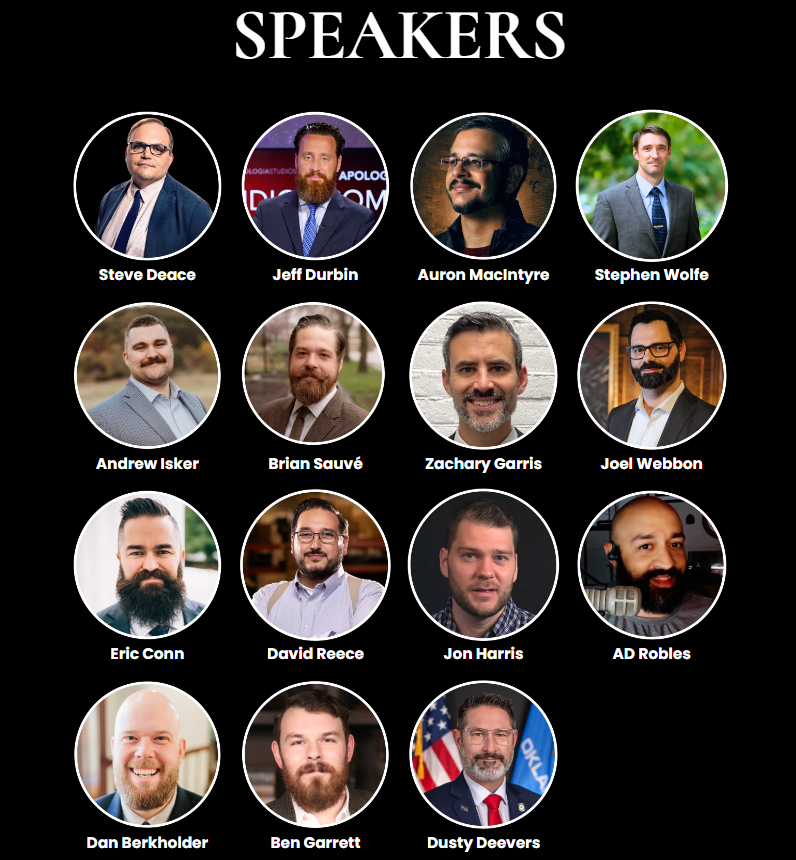
Finally, I’d like to point out that I am not unfairly lumping people together who are not part of the same movement. Engel and Isker are podcast co-hosts. Wolfe and the author of the Identity Dixie article were podcast co-hosts. Engel, Isker, and Wolfe have all been interviewed and platformed by prominent Christian nationalists. And next year, Wolfe and Isker will be speakers at a conference with numerous Christian nationalists whose theme is “Christ Is King! How to Defeat Trashworld.” Therefore, to identify ideas common to these men and their fans seems entirely legitimate and even crucial if we want to understand their project.
IV. Positives
Before I offer critiques of the “woke right,” I’d like to offer some suggestions about what we can learn from the movement.
First, some of their claims about disdain towards Whites are accurate. If you’re inclined to scoff at this idea, please consider that you may be part of the problem. Secular progressives can mock and disparage White people with few repercussions. Even professing Christians can write entire books based on the premise that White men are “apex predators” who suffer from “shriveled heart syndrome.”
We’re often told (sometimes explicitly) to overlook bitter, angry, or even abusive statements from people of color because of the racism they’ve suffered. I think this posture can be an appropriate application of biblical forbearance and gentleness. But does it go both ways? If we excuse egregious statements made by people of color, why do we call down fire on a White person who accidentally says something slightly insensitive? Equal weights and measures, friends. If we’re going to exercise charity and patience, let’s exercise it towards everyone.
Hans Fiene of Lutheran Satire recently created a hilarious video entitled “Is This Christian Nationalism?” In it, a disaffected young White teenager with an anime avatar spews insane Dissident Right talking points about “racial suicide” and global Jewish conspiracies. But Fiene (like Doug Wilson) recognizes that there’s a backstory behind the angst of every racist 4chan edgelord. If you value “lived experience,” maybe it’s worth asking more about his before you scream at him.

Second, the “woke right” (and the Christian nationalist movement with which it’s often associated) can help us interrogate the biblical basis for the beliefs we take for granted. They ask “forbidden” questions like “What’s wrong with racism?” or “Why should we support free speech?” or “Why think a theocracy is bad?” Too often, our only answers are spluttering rage followed by vague appeals to “the Imago Dei.” The truth is, we’re often the unreflective product of our environments. We tend to believe what everyone around us believes. Therefore, it’s always healthy for us to return to Scripture and sincerely ask: “What does God say?”
As a side note, “postliberalism” asks the same kinds of questions as the woke right but is certainly not identical to it. Postliberalism also seeks to rethink the political assumptions of Enlightenment liberalism, but generally rejects the critical and ethnocentric framing of the woke right. So it would be accurate to affirm that the woke right is postliberal (more accurately, anti-liberal), but that not all postliberals are part of the woke right.
Third, the “woke right” properly challenges our commitment to “niceness.” The Bible does indeed command us to live at peace with all men (insofar as it depends on us – Rom. 12:18), to not be quarrelsome (2 Tim. 2:24), and to treat others with gentleness and respect (1 Pet. 3:15). However, the Bible also repeatedly commands us to hate sin and promises that if we follow Christ the world will (not may) hate us (Matt. 10:22, John 15:18-25). Too many of us, myself included, feel that we must at all times act as inoffensively as possible towards non-Christians and that if we fail to do so, we are “harming our witness.” This is incorrect.
However, there is another, perhaps worse, indictment of our demeanor. We don’t actually display a uniformly winsome and irenic posture. When we say that abortion or homosexuality is sinful, many of us will walk on eggshells to avoid offending non-Christians who are pro-choice or LGBTQ. But we have no problem boldly proclaiming the evils of racism, and give no thought to offending non-Christians who are racist. What’s going on? Uniform winsomeness and uniform bluntness make sense. What makes much less sense is blasting sins that are culturally unpopular and then stammering uncomfortably when asked about sins that are culturally popular.
V. The Dangers of the Woke Right
Despite the handful of positive lessons we can learn from the woke right, I see many more dangers. Specifically, I am troubled by the fact that the woke right is embracing the ideas and methods of critical theory, which are fundamentally false and deeply corrosive. That is my position whether critical theory is embraced by the right or the left.
A. Context-less Hegemonic Power
First, critical theory’s conceptualization of hegemonic power (the idea that certain groups impose their values on culture in a way advantages the dominant group) is incorrect because it ignores context. For example, numerous careful sociological studies show that Blacks are discriminated against relative to White candidates in job interviews (see the studies of Pager et al.). Critical theorists take this finding as evidence that we live in a White-supremacist nation. However, it is equally true that Whites are discriminated against relative to Blacks and Hispanics in elite college admissions (see the recent Supreme Court decision). Is that evidence that we live in a Black- and Hispanic-supremacist nation? Or consider a cultural example. What norms are hegemonic in rural Idaho? On a highly progressive college campus? In South Central LA? In San Francisco’s Chinatown? The answer is entirely dependent on your physical (and cultural) location.
Critical theory (on the right or on the left) offers a simplistic and therefore incorrect answer. It has to posit a single, universal hegemonic discourse that drives society and serves as the foil to its radical program of social transformation. And that leads to my second major concern.
B. Adversarial Identities
The woke right and woke left demand that we internalize our status as victim. Progressives want women and people of color and the poor and LGBTQ people to feel like they are besieged, like they constantly face a barrage of marginalization and disdain. How different is the woke right? Even a brief perusal of the sources I quoted above shows that they very much want straight White men not only to recognize that they are victims, strangers in their own country, but to internalize this identity.
Again, my objection to critical theory on the right or on the left is based on the question: what will this do to the church? How can a Christian walk into church on Sunday, look around at his fellow believers, and think to himself “oppressor Christian…oppressor Christian…oppressed Christian”? How can he fail to harbor a secret grievance against his Black (or White) co-worker who he just knows is receiving special treatment? Won’t he come to realize that his Real Community consists of all those Woke (or Based) people online who Really Understand his struggles? How can he not become frustrated with his unwoke (or normie) pastor who fails to see how the deck is stacked against him? I have always warned that wokeness will tear the church apart. And that’s true no matter what flavor of wokeness we embrace.
Also, keep in mind that wokeness admits of no ecclesiocentric (i.e. church-based) solution to the problems it discovers. Wokeness is primarily a political project. According to its proponents, the only solution to the marginalization of straight White men (or LGBTQ Black women) is the radical transformation of our nation’s government and culture. That is why woke churches eventually loosen their hold on the gospel to free up resources for sociopolitical activism. We saw this clearly on the woke left. We will see it on the woke right.
In fact, one notable sign that the woke right –like the woke left– priorizes politics over theology is the ecumenical and even inter-religious nature of the movement. Catholics, the Eastern Orthodox, and evangelical Protestants will lock arms while strategizing their defeat of Trashworld. The woke right also borrow language and concepts from lapsed-Catholic Nazi jurists like Carl Schmitt (“the friend/enemy distinction”) and Nietszcheans like Bronze Age Pervert (“the longhouse”). Whereas organizations like Together for the Gospel tried to unite people around a shared theology, the woke right unites people around anti-Regime activism.
C. Critical Consciousness
Third, both the “woke right” and the “woke left” appeal to the idea of a critical consciousness.
Neo-Marxists believe that oppressed people are blind; they don’t even realize they have been brainwashed by racist, capitalist, cisheteropatriarchal discourses. To truly grasp reality, they need to “get woke” so that they can “see through” the narratives that have subjugated them.
In the same way, the “woke right” believes that “normies” (i.e. those who affirm the “acceptable” beliefs of 21st-century American culture) are blind; they don’t even realize they are brainwashed by effeminate, fake-and-gay discourses of the post-war consensus. To truly grasp reality, they need to get based and red-pilled, so that they can “see through” the narratives that have emasculated them.
In practice, these assumptions make appeals to reason or logic or Scripture nearly impossible because they require us to “see through” people’s arguments to discover the “real” reasons that they are making particular claims. We immediately recognize this cynical perspective when it’s deployed by progressives:
“Oh, you don’t think that all racial disparities are the result of systemic racism? How convenient that you won’t need to give up any of your racial power and privilege!”
“Oh, you think that only men should be pastors? How convenient that your interpretation of the Bible just happens to coincide with 19th-century gender politics!”
“Oh, you don’t think that Jesus was a socialist? How convenient that your theology just happens to align with your political views!”
Compare that reasoning to these Tweets from Stephen Wolfe:
“How convenient for us that the Gospel inaugurated a political project so consistent with the unrestricted labor flow preferences of global neo-liberalism.” – Oct 8, 2020
“How convenient for you that the Gospel inaugurated a social project so similar to your early 21st century egalitarian ideology.” – Mar 10, 2021
“How convenient for us that neo-calvinist ‘grace restoring nature’ requires us to affirm early 21st century democratic pluralism.” –
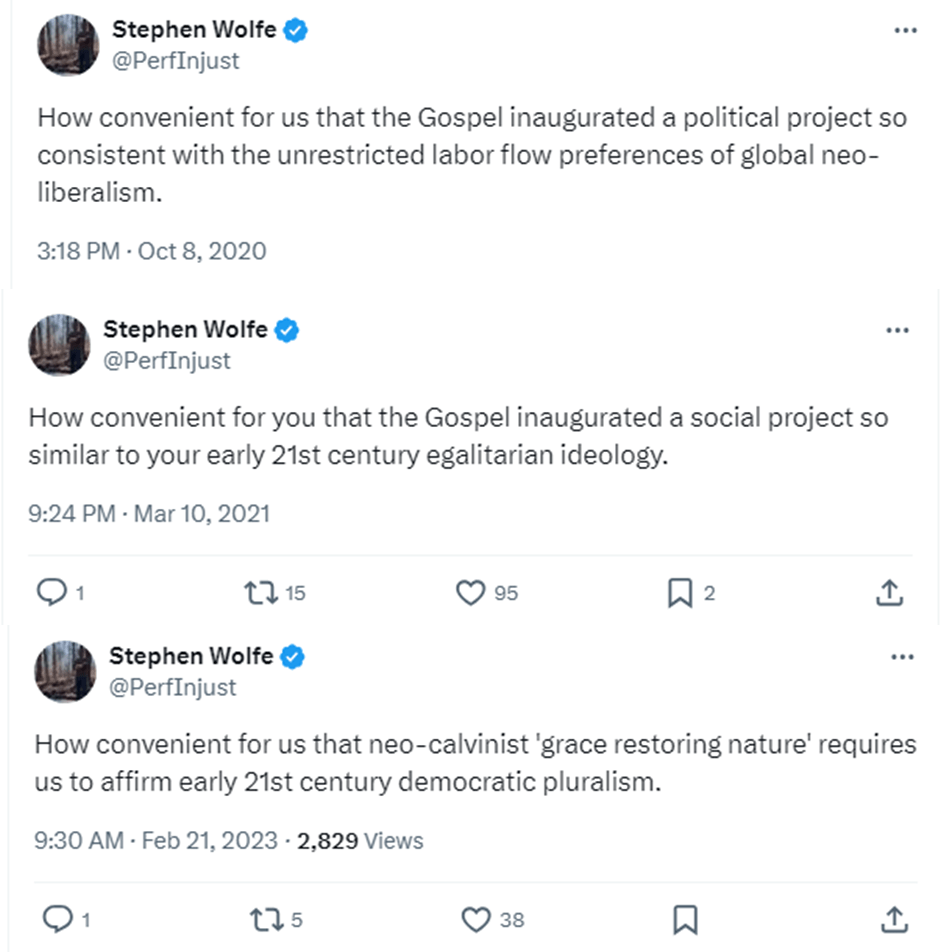
Note that Wolfe is not making arguments here at all. He’s simply implying that all the claims he mentions can be dismissed as excuses to justify or to curry favor with The Regime (e.g. global neo-liberalism, egalitarianism, democratic pluralism). This is an incredibly destructive (and deconstructive) method of non-reasoning. Again, I raised the same criticisms with the woke left: once you accept the idea that all truth claims can be dismissed as mere power plays, no claim will emerge unscathed. In fact, this reasoning devours itself: “Isn’t it convenient that your woke-right political philosophy wants to consolidate power in the hands of straight White men like yourself!”
Moreover, this approach to truth leads to a purity spiral. Once you accept the argument that you are blind to the ways your reasoning itself has been corrupted, there is no easy way to push back against any claim that the woke decide to make. Do you think that the Civil Rights Movement was good? That’s because you’ve been socialized into the postwar consensus. Do you think that you shouldn’t call women “used mattresses” and “whores”? That’s because you’re effeminate. Do you think Christians shouldn’t run around the Internet calling things fake and gay? That’s because you’re fake and gay. Oh, you think the Bible actually supports all your claims? That’s just your postwar consensus, effeminate, fake-and-gay interpretation of the Bible.
In the end, the woke aren’t appealing to reason or to logic or even to the Bible. They’re appealing to vibes. The woke have secret knowledge of the Way Things Actually Work. If you disagree, it’s only because you’re still captive to The Regime. This way of thinking is corrosive anti-knowledge, regardless of whether the left or right makes use of it.
D. Ethnocentrism
Fourth, ethnic identitarianism, meaning the exaltation of your ethnic identity over your identity in Christ, is a major problem on both the woke left and the woke right. On the one hand, having an ethnic identity is not sinful, any more than it’s sinful to have a family identity, a regional identity, or a national identity or to identity with a hobby or with your favorite baseball team. On the other hand, Phil. 2 teaches that all our identities are to be counted as “rubbish” or “dung” compared to the surpassing worth of knowing Jesus. Moreover, passages like Gal. 3:28 and Eph. 2:11-22 insist that we are all one in Christ, not in the sense that our other identities do not exist, but in the sense that we are united in Christ to a degree that radically relativizes our ethnic differences or even our familial relationships (Matt. 12:48-50).
[Aside on racism — feel free to skip if you already understand why racism is a sin]
Five years ago, the unquestioned assumption of evangelicals, even strongly anti-woke evangelicals like James White or Voddie Baucham, was that racism is a grievous sin and a blight on the church. Unfortunately, that seems to no longer be the case among many of those on the “woke right.” To be clear, this problem is not merely the result of the expansive re-definition of “racism” that has been adopted by the Left. Even when I’ve criticized “ethnic partiality” (again, the preferred terminology of pastors like White and Baucham), I’ve been asked why ethnic partiality is –in fact– a sin. “What’s wrong with loving your kin?” is the immediate rejoinder.
For that reason, I’d like to give a brief explanation of why “racism” or “ethnic partiality” is a sin.
“Ethnic partiality” is a sin because it is a species of “partiality,” which is repeatedly named in the Bible as a sin that is inconsistent with God’s character (Deut. 1:17, 1 Tim. 5:21, James 2:1-13 c.f. Deut. 10:17, Rom. 2:11; Eph. 6:9, Acts 10:34).
The rejoinder here is that not all preferences are condemned. After all, shouldn’t we love our children more than a stranger’s children or members of our local church more than people we’ve never met? Here, the racism-skeptic will point to the Ordo Amoris, the right ordering of loves described by St. Augustine in The City of God. The racism-skeptic’s argument runs roughly as follows:
God commands us to love all people, but also commands us to have a special love for those nearest to us. This affection is not only good and natural, but is prescribed in the Fifth Commandment. It is assumed even in the “hard teachings” of Jesus. For example, Jesus’ command to love him more than we love our father or mother or sisters or brothers (Matt. 10:37) is predicated on us having a special love for our family, which is why he didn’t say “love me more than you love strangers.” The commands of Jesus are radical precisely because they ask us to expand our circle of concern; they don’t assume such a circle doesn’t exist at all. Throughout the Bible we find commands to love and honor certain people above others (our parents, our children, our rulers, our pastors, our church, fellow believers, etc.). None of these commands permits us to hate our neighbor, but all of them assume that rightly ordered loves will prioritize those with whom we have a special relationship.
Once we establish that there is a natural and God-ordained hierarchy of loves, the principle of kin-love follows. Our greatest duty is towards our immediate family. Then our duties expand outward to our extended family, our distant relatives, our clan, and our own ethnic group until only later reaching other ethnic groups. Loving other ethnic groups more than our own ethnic group would be as perverse as loving distant relatives more than we love our children. Therefore, what you call “kinism” or “racism,” is actually a thoroughly biblical and God-ordained hierarchy of loves.
This argument is persuasive to some because many evangelicals (and secular progressives to an even greater degree) have lost any sense of the Ordo Amoris. We sometimes talk as if we have sinned if we don’t love distant strangers just as much or perhaps even more than we love our children. This is not only infeasible (can you actually love all 72 million inhabitants of Thailand?) but contradicts the Bible’s repeated injunctions that we should, in fact, show love to our own spouses and children and parents and fellow Christians more than we show love to people we’ve never met (Ex. 20:12, John 13:35, Eph. 5:22-6:4, Gal. 6:10). Consequently, many evangelicals are not well prepared to answer the reasoning of the racism-skeptic.
That said, the major problem with the racism-skeptic’s argument is how it answers the question “And who is my neighbor?” the very question the Pharisee posed to Jesus in Luke 10 in an attempt to justify himself. Jesus replied with the parable of the good Samaritan, the story of an ethnic outsider and hated enemy of the Jews who shows love and compassion to a Jewish man who is robbed and beaten. Jesus’ command to “Go and do likewise” exposes the Pharisee (and us) in the most devastating way. The Pharisee wanted to circumscribe the people whom he was commanded to love. Jesus would not allow it. Jesus’ parable shows us how far we all fall short of the glory of God precisely because it refuses to limit the bounds of our neighbor-love to “our people.”
The solution to the tension between “loving our neighbor” and “loving those closest to you” is to recognize that “as [the Samaritan] traveled, [he] came where the man was” (Luke 10:33). Yes, in principle, we are to love all people everywhere. But your neighbor is not “all people everywhere.” Neither is your neighbor “only people from your own ethnic group.” Instead, your neighbor is anyone along your path, anyone you meet, anyone in front of you at the moment. In the most concrete possible way, this principle not only undermines progressive notions of abstract universal love, it also undermines racist ways of abstractly “loving your own.” Jesus commands you to love the person actually in front of you regardless of whether they are “one of your own” or a member of an ethnic group that your ethnic group hates.
The biggest problem with racism is not the fact that you “love your own” but the fact that you fail to love your neighbor. Racists justify their ethnic partiality by constructing a completely abstract hierarchy in the name of “rightly ordered loves.” But if they fail to love the actual neighbor right in front of them, that failure –ironically– reveals deeply disordered loves!
A practical illustration will be helpful here. Imagine a White Christian whose church calls a new pastor, who happens to be Black. The new pastor is orthodox, godly, and humble, but the White man leaves the church because he “feels more comfortable with his own people” and defends his actions on the grounds that he is “just loving his kin.” In fact, the man is sinning because his loves are disordered. He loves abstract White people, whom he has never met, more than he loves the pastor of his own church, a member of his spiritual family whom he is specifically commanded to honor and submit to (John 13:34-35, Heb. 13:17, 1 Tim. 5:17).
This problem is particularly acute in our society. We can speculate all we want about an “ideal” ethnostate composed of nothing but our own group. However, the vast majority of people in the United States live with, work with, interact with, and attend church with people of many different ethnic groups. Therefore, if you disobey Jesus’ command to love your actual neighbor by speculating about how he would not be your neighbor at all in your imaginary ideal society, you are making precisely the same mistake the Pharisee made with precisely the same motivation. You might as well tell Jesus that you won’t honor your actual parents because, in the imaginary family you invented in your mind, you are the child of Chuck Norris and Wonder Woman.
In summary, “racism” or “ethnic partiality” can be defined as showing partiality toward your ethnic group such that you violate the second greatest commandment: to love your neighbor as yourself. Given that Jesus explains the command to love your neighbor as yourself in terms of treating others the way you want to be treated, a simple test of ethnic partiality is this: would you want your neighbor to treat you the way that you treat him? In other words, would you want him to give the job to a less qualified candidate who shared his ethnicity? Would you want him to ignore you when you visited his church? Would you want him to ascribe negative stereotypes to you because of your ethnicity?
I hope it goes without saying that using racial slurs or even intentionally saying things that will needlessly offend others is sinful because it violates God’s commands regarding our speech (Eph. 4:29, Col. 4:6, Matt. 15:11, Eph. 5:4, James 1:26, etc.)
[End of Aside on Racism]
My co-author Dr. Pat Sawyer first grew concerned with the evangelical social justice movement when he noticed that some Christians were coming to view their ethnic identity as the primary lens through which they viewed themselves and the world. I have precisely the same concern when it comes to the woke right.
For example, in his Case for Christian Nationalism, Stephen Wolfe writes that “People of different ethnic groups can exercise respect for difference, conduct some routine business with each other, join in inter-ethnic alliances for mutual good, and exercise common humanity (e.g., the good Samaritan), but they cannot have a life together that goes beyond mutual alliance” (p. 148; note that here Wolfe is using an unusual definition of “ethnicity” that includes but is not limited to ancestry). This is completely wrong, not just as a piece of political philosophy, but as a matter of ecclesiology.
The local church is called to have a “life together”; indeed, we are called to have Christ’s life together. We are a family and we are called to see ourselves as a family. We are called to view one another as brothers and sisters bound with spiritual ties even stronger than those that bind our biological family.
The problem of ethnic identitarianism suffuses the “woke right” but is often given a pass because wokeness is viewed as a political project. In other words, because the woke right is concerned with the nature of a “nation,” what constitutes a “people,” and whether the U.S. government ought to center the needs and culture of Anglo-Protestants, it can insist that its views are unrelated to spiritual concerns; they deal only with temporal politics.
However, political speculations will almost unavoidably impact the day-to-day realities of our spiritual life. For example, is it really plausible to think that a woke right Christian who believes that U.S. culture and government ought to center Anglo-Protestant norms will never be tempted to think that his local church culture ought to center Anglo norms as well? Is there really no danger that he will turn his cultural preferences into cultural imperatives?
For example, CJ Engel, who argues that U.S. politics should be oriented towards “Heritage Americans” has repeatedly expressed his dislike (to put it mildly) for rap, hip-hop, and even jazz, making (hopefully) hyperbolic statements like:
(We’re going to ban rap, hip-hop, and jazz) – Oct 23, 2023
And:
Rap is incredibly retarded, culturally subversive, aesthetically debased, and musically degenerate. Jail time. –
And:
The anti-Western genres of hip hop and rap, born in the ghettos of urban America, now terrorize and occupy the bourgeois suburbs. This is the true crisis in our midst. – Aug 16, 2023
And:
Monthly reminder that Rap and Hip-Hop are subversive of Western Culture and are to be banned and its propagators jailed. –

How likely is it that Engel and his followers will be able to (or will even want to) draw a sharp boundary between these “political” views and their views toward varied cultural expression within the church?
Speaking more broadly, I see on the “woke right” an overcorrection to the ubiquitous but obviously false mantra “diversity is our strength.” For instance, a diversity of beliefs about the morality of rape is not a strength within a culture. A diversity of athletic ability is not a strength on a professional sports team. A diversity of ethnicities in a business meeting is not a strength if no one speaks a common language. Clearly, diversity can be either good or bad depending on the context.
However, the overcorrection against diversity ignores Scripture’s repeated command to subordinate our personal preferences for the benefit of others (Rom. 14, 1 Cor. 10). Even where diversity is not a strength it can still be embraced as an outworking of Christian love. A knee-jerk revulsion towards diversity also ignores the historical dictum “In essentials unity, in non-essentials liberty, in all things charity.” If this rule applies to non-essential theological differences, how much more should it apply to differences in mere cultural preference?
E. Godless speech and behavior
Finally, anyone who has spent time online has probably noticed a pattern of reprehensible behavior from the woke right. The woke right’s social media posts are suffused with scorn, ridicule, mockery, and sneering, which qualify as “unwholesome talk” and are therefore sinful (Eph. 4:29-32), especially when they’re directed toward fellow believers (Matt. 5:22). Yet many on the woke right exult in calling other Christians (conservative evangelical Christians, for what it’s worth) “fake and gay,” “losers,” “trash,” “garbage,” “limp wristed,” “fags,” etc.
I’d like to be able to say that such comments are only made by laser-eyed anons with names like @ChadTheBasedGroyper17 but, unfortunately, major accounts gleefully participate in this behavior too. If that’s you, remember: you will give an account of every careless word uttered. Repent and receive forgiveness.
Even among those who frown on these actions, there is an unwillingness to break ranks or even to admit that a problem exists because of their adherence to the principle of “no enemies to the right” (NETTR). Briefly, NETTR insists that the Left is such a tremendous threat to the very existence of America that those on the Right should never publicly critique others on the Right, even if they offer private criticism. I’ve argued elsewhere that this strategy is biblically impermissible.
However, my bigger concern is that a commitment to NETTR will dull people’s consciences. I’ve been personally grieved by the trajectory of some of my friends. Indeed, I’m certain that if their 2022 selves could see what they’re now comfortable with, they too would be horrified. But they are so confident in the righteousness of their cause that they will either downplay or deny outright the misbehavior of their allies and will cast aside the warnings of pastors and theologians they respect.
Sadly, we witnessed the same dynamics in 2018 on the woke left. Rather than exposing the problems in their midst, woke evangelicals were so confident in the righteousness of their cause that they circled the wagons, put their fingers in their ears, and accused their critics of being racist. Today, we’re watching the woke right follow the same path, circling the wagons, putting their fingers in their ears, and accusing their critics of being fake-and-gay progressives. If you refuse to learn from the mistakes of the left, you will repeat them.
Summary
In this article, I’ve argued that “woke right” is a reasonable label for an actual movement that has embraced the same ideas as the woke left. I’ve then argued that these ideas should be rejected by Christians for precisely the same reasons that we reject them when they’re championed by progressives. That said, the labels we use are far less important than the actual ideas involved. If people find the label “woke right” unhelpful or confusing, it’s fine to substitute another term like the “Dissident Right” or the “New Right.”

Two final thoughts.
To those who complain that the political threat of the woke right is negligible, I agree. Although the situation may change, the “woke right” is a tiny, marginal movement. In contrast, left-wing wokeness is a dominant ideology in nearly every area of society: politics, media, education, business, sport, even religion. Yet even when combatting left-wing wokeness, my primary concerns have never been political; they have always been spiritual. Woke ideas are false and corrosive to the Christian worldview. They will poison the spiritual health of the church and the spiritual life of the individual. Therefore, it doesn’t matter which version of wokeness poses a greater political threat; both should be rejected on theological grounds.
Finally, to those who are sick of left-wing wokeness, are frustrated by many evangelicals’ capitulation to it, and are casting about for some solution, any solution, to the problems we’re facing as a culture, please be careful. Do not let your frustration blind you to the serious problems on “your team.”
In 2020, after years of hitting a brick wall when I tried to convince evangelicals that critical theory was a serious threat to the church, I urged woke-sympathetic Christians to identify a “‘woke theology’ breaking point,” to draw a line in the sand that would convince them that a real problem existed. This year, I offered the same admonition to dissident-sympathetic Christians:
Christians also need to identify a “Dissident Right breaking point” by asking similar questions: 1) how much racism/misogyny/anti-Semitism do you need to see in your group chat before you leave? 2) how often do white nationalists have to like your Tweets before you start wondering why you’re attracting them? 3) how many orthodox theologians whom you admire have to raise such concerns before you’ll listen to them?
Answer these questions and then hold yourself accountable.
UPDATE (11/27/2024): For clear evidence that the radical Right has embraced the ideas of Neomarxist Antonio Gramsci, see my review of Abrahamsen et al.’s 2024 book World of the Right.
Related articles:
- Neomarxism Revisited: A Short Review of Abrahamsen’s World of the Right
- Of Gods and Men: A Long Review of Wolfe’s Case for Christian Nationalism, Part I – Book Summary
- Toppling Trashworld: A Long Review of Isker’s Boniface Option
- NETTR Debate: Haywood and Fischer v. Shenvi and Young
- Black Mirror: Talking About Race in 2024
 Neil Shenvi - Apologetics