
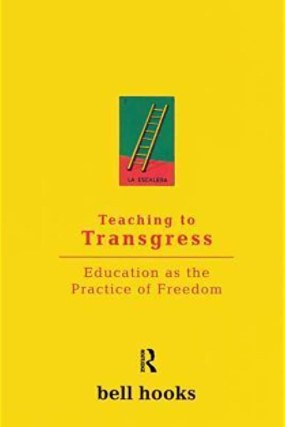
bell hooks is a noted feminist, social activist, and educator. Her book Teaching to Transgress is best characterized as critical pedagogy, but even a cursory read shows how deeply the ideas of critical race theory, feminism, postcolonialism, and neo-Marxism have become intertwined within an “intersectional” framework. Much of the book was relatively benign, consisting of hooks’ musings on her career in education and her interaction with her students. But the ideas (dare I say worldview?) that undergird her thoughts surface on numerous occasions.
Contemporary critical theory is based on four basic ideas: 1) the social binary, 2) oppression through ideas, 3) lived experience, and 4) social justice. Below, I’ll offer a handful of representative quotes and explain how they fit into this basic framework.
The Social Binary
Contemporary critical theorists believe that society is stratified into oppressed groups and oppressor groups along lines of race, class, gender, sexuality, physical ability, and a host of other identity markers. These oppressions must all be dismantled simultaneously. Relatedly, a single person can be “intersectionally” oppressed if they simultaneously occupy multiple oppressed categories, giving them a unique social location. hooks affirms this idea in several places.
“the work of various thinkers on radical pedagogy (I use this term to include critical and/or feminist perspectives) has in recent years truly included a recognition of differences–those determined by class, race, sexual practice, nationality, and so on” (p. 9)
“I have placed alongside the struggle to end racism a commitment to ending sexism, and sexist oppression, to eradicating systems of class exploitation” (p. 27)
“I have not forgotten the day a student came to class and told me: ‘We take your class. We learn to look at the world from a critical standpoint, one that considers race, sex, and class. And we can’t enjoy life anymore.'” (p. 42, note the allusion to a ‘critical standpoint’).
“Patricia Williams… writes that even those of us who are ‘aware‘ are made to feel the pain that all forms of domination (homophobia, class exploitation, racism, sexism, imperialism) engender” (p. 74)
“Identity politics emerges out of the struggles of oppressed or exploited groups to have a standpoint on which to critique dominant structures, a position that gives purpose and meaning to struggle. Critical pedagogies of liberation respond to these concerns and necessarily embrace experience, confessions and testimony as relevant ways of knowing, as important, vital dimensions of any learning process” (p. 88-89)
“Historically, white female efforts to maintain racial dominance were directly connected to the politics of heterosexism within a white supremacist patriarchy” (p. 95)
Oppression Through Ideas
Contemporary critical theory redefines the word “oppression” to include the ways in which dominant, oppressor groups impose their values on society such that they are taken as “natural” or “objective” and are seen as “common sense.” This phenomenon is known as “hegemony.” Thus, oppression is fundamentally ideological. It is mediated through systems like “whiteness” and “the patriarchy.”
hooks adopts this framework.
“We learned early on [as students] that our devotion to learning, to a life of the mind, was a counter-hegemonic act, a fundamental way to resist every strategy of white racist colonization.” (p. 2; note the use of the term “counter-hegemonic”).
“White women who have yet to get a critical handle on the meaning of ‘whiteness’ in their lives, the representation of whiteness in their literature, or the white supremacy that shapes their social status are now explicating blackness without critically questioning whether their work emerges from an aware antiracist standpoint” (p. 104)
“The erasure of the body [e.g. ignoring where the professor stands, how physically close they are to students. etc.] encourages us to think that we are listening to neutral, objective facts, facts that are not particular to who is sharing the information” (p. 139)
Lived experience
People who are not oppressed are blinded by their privilege. In contrast, the hegemony of the ruling class can best be recognized through the lived experience of marginalized groups. Therefore, we should refer to the lived experience of the oppressed. hooks:
“One white woman…. suggests that the degree to which a white woman can accept the truth of racist oppression–of white female complicity, of the privileges white women receive in a racist structure–determines the extent to which they can be empathetic with women of color” (p. 106)
“The power of [non-standard English] speech is not simply that it enables a resistance to white supremacy, but that it also forges a space for alternative cultural production and alternative epistemologies–different ways of thinking and knowing that were crucial to creating a counter-hegemonic worldview” (p. 171)
This final statement is crucial. hooks is not offering some narrow analysis of one particular phenomenon. Nor, as a practitioner of critical pedagogy, is she merely describing a specific approach to education. Rather, her work is best viewed as commending a particular worldview.
Related articles:
 Neil Shenvi - Apologetics