
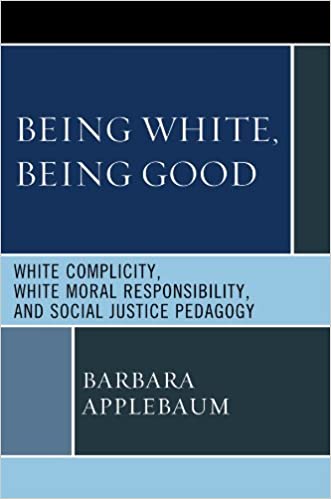
Barbara Applebaum’s Being White, Being Good is a lengthy defense of “white complicity” which is the claim that “white people, through the practice of whiteness and by benefiting from white privilege, contribute to the maintenance of systemic racist injustice” (p.3). She reiterates this central thesis at numerous points in her book:
“As [Sandra Bartky] emphasizes, ‘On my view, I am guilty by virtue of simply being who I am: a white woman, born into an aspiring middle-class family in a racist and class-ridden society.’…The relevant point for now is that all white people are racist and complicit by virtue of benefiting from privileges that are not something they can voluntarily renounce” (p. 16)
“A conception of responsibility is necessary that can explain how even those who are committed to acknowledging complicity are not absolved from complicity and that no white person is morally innocent, that no white person can stand outside the system” (p. 46)
“The white complicity claim maintains that all whites, by virtue of systemic white privilege that is inseparable from white ways of being, are implicated in the production and reproduction of systemic racial injustice. Uncovering systemic white ignorance and white denials of complicity that are so prevalent in everyday white discourse and practices and that protect white moral innocence facilitates our understanding of the connection between systemic benefit and the maintenance of the racial system” (p. 179).
Casual readers will likely see Applebaum’s project as an element of critical race theory, but Applebaum herself is somewhat vague about how her work should be classified, referring to it alternatively as part of “critical whiteness studies” (p. 2), “social justice education” (p. 2), “social justice pedagogy” (p. 3), or “white complicity pedagogy” (p. 4).
This kind of semantic ambiguity is, unfortunately, quite common. Fortunately, we can focus on key ideas that are repeated throughout Applebaum’s book and which are echoed in critical race theory literature.
Racism is pervasive and systemic
One of the core, “defining elements” of critical race theory is the belief that racism is normal, permanent, pervasive, and systemic. Applebaum affirms this idea:
“What is of specific interest about white complicity is the claim that white people can reproduce and maintain racist practices even when, and especially when, they believe themselves to be morally good” (p. 3)
“White complicity in systemic racial injustice is often associated with having white privilege. As Sandra Bartky puts it, ‘…most people in this country are complicit in an unjust system of race relations that bestows unearned advantages on them while denying these advantages to racial Others.’ Those who take such a position envision racism as a system of group privilege that white people benefit from and that simultaneously marginalizes all people of color. Racism so understood entails that all white people are racist or complicit by virtue of benefiting from these privileges even though these privileges are not something they can voluntarily renounce” (p. 27)
All Whites Benefit from Racism
The “race realism” of CRT insists that racism is not merely individual racial animus, but a system of advantage that accord whites with certain material privileges. Applebaum affirms this idea:
“Whites… benefit from white privilege in a very deep way. As Zeus Leonardo remarks, all white people are responsible for white dominance since their ‘very being depends on it.’” (p. 31)
“I am looking for a conception of moral responsibility that can ground the claim that all white people are complicit in sustaining systemic injustice, not because they have particular bad intentions or bad attitudes against those who are not white, but by virtue of being a member of a social group that benefits from such systemic injustices” (p. 120)
“The white complicity claim maintains that all whites are complicit in systemic racial injustice and this claim sometimes takes the form of ‘all white people are racist.’ When white complicity takes the latter configuration what is implies is not that all whites are racially prejudiced but rather that all whites participate in and, often unwittingly, maintain the racist system of which they are part and from which they benefit” (p. 140)
Whites are Blind to Racism
Critical race theorists believe that racism is so pervasive that it is perceived as “natural” and “ordinary.” Whites in particular are blind to the presence of racism. Peggy McIntosh, in her seminal paper on “white privilege,” referred to its transparency (i.e. invisibility); white privilege is not noticed by those who have it. Applebaum strongly affirms this idea as well:
“Systemic white ignorance makes denials of complicity seem justified and this, in turn, protects white moral innocence, on the one hand, and shields unjust systems from being interrogated, on the other” (p. 7)
“White ignorance… generates specific types of delusions or wrong ways of perceiving the world that are socially validated by the dominant norms and protect those norms from being interrogated” (p. 38)
“Because of white ignorance, white people will be unable to understand the racial world they themselves have made. One of the significant features of white ignorance is that it involves not just ‘not knowing’ but also ‘not knowing what one does not not and believing that one knows.’ White ignorance is a form of white knowledge. It is a type of ignorance that arrogantly parades as knowledge.” (p. 39)
“In considering white complicity, however, the practices under consideration are often so normalized that their status as morally wrong is exactly what is being contested. White complicity involves practices that white people often consider ‘harmless’ and even ‘benevolent’” (p. 124)
“it is specifically a lack of such a feeling of responsibility (such complicity is denied) that is characteristic of white complicity. Denials of white complicity, furthermore, are camouflaged by seemingly morally honorable virtues, for instance, assertions of ‘colorblindness.’ It is the connection to seemingly moral behavior that contributes to the resistance and that makes explaining white complicity so difficult” (p. 125)
Whiteness is a Ideology
Colloquially, “whiteness” is primarily understood as a reference to someone’s skin color. However, critical race theory understands whiteness to be an ideology in which anyone can participate regardless of ethnicity. Applebaum adopts this conceptualization of whiteness:
“Even when white people acknowledge their complicity, their white confessionals or public self-disclosures can serve to reinscribe privilege and offer redemption from complicity…Confessions of whiteness, therefore, constitute a form of pleasurable relief because what has produced the discomfort of learning about complicity is removed and one is purged of wrongdoing.” (p. 19
“even the morality of the critic of whiteness must be interrogated for whitely ways… For instance, in declaring ‘I am racist’ or ‘I am complicit,’ the white critic of whiteness actually implies the opposite: ‘I am not racist’ or ‘I am not complicit.’ Somewhat like the person who declares ‘I am modest’ is clearly not a modest person, Ahmed cautions the white critic of whiteness that the assertion that ‘I am a bad white’ can indirectly entail that ‘I am really a good white.'” (p. 19)
“even when white people act against the norm of whiteness, one does not become innocent and removed from power matrices because privilege is reproduced regardless of intent. Even when whiteness is disavowed, whiteness is reiterated” (p. 85)
“Many universities now include in their curriculum courses whose primary objective is to understand, analyze and challenge oppressive social systems, courses that aim to critically examine dominant norms (such as, for example, whiteness and heteronormativity) on the basis of which ‘difference’ is constructed” (p. 105)
Skepticism Toward Truth
Finally, like all critical social theories, critical race theory is skeptical toward claims of objective truth. It views such claims, along with appeals to reason, logic, and evidence, as mechanisms for by which the ruling class conceals its oppression. Applebaum makes this claim very explicit:
“Critical thinking advocates are primarily concerned with ideals of autonomy and presume that reasons and rationality are the routes to the ‘examined life.’… Critical Pedagogy, in contrast, begins from a very different premise. Critical Pedagogy starts out with the understanding that systems of power and knowledge are linked in ways that support social injustice. Criticality is primarily understood as the practice of interrogating those systems of power, its truth regimes and the discourse through which such power circulates. The question ‘who benefits’ is prior to questions of truth because ‘a crucial dimension of this approach is that certain claims, even if they might be “true” or substantiated without particular confines and assumptions, might nevertheless be partisan in their effects.'” (p. 187-188)
In summary, Applebaum’s book is a canonical example of the kinds of arguments that undergird much of progressive thought about race, which are rooted in the central ideas of critical race theory.
See all content on critical theory here.
Related articles:
 Neil Shenvi - Apologetics