

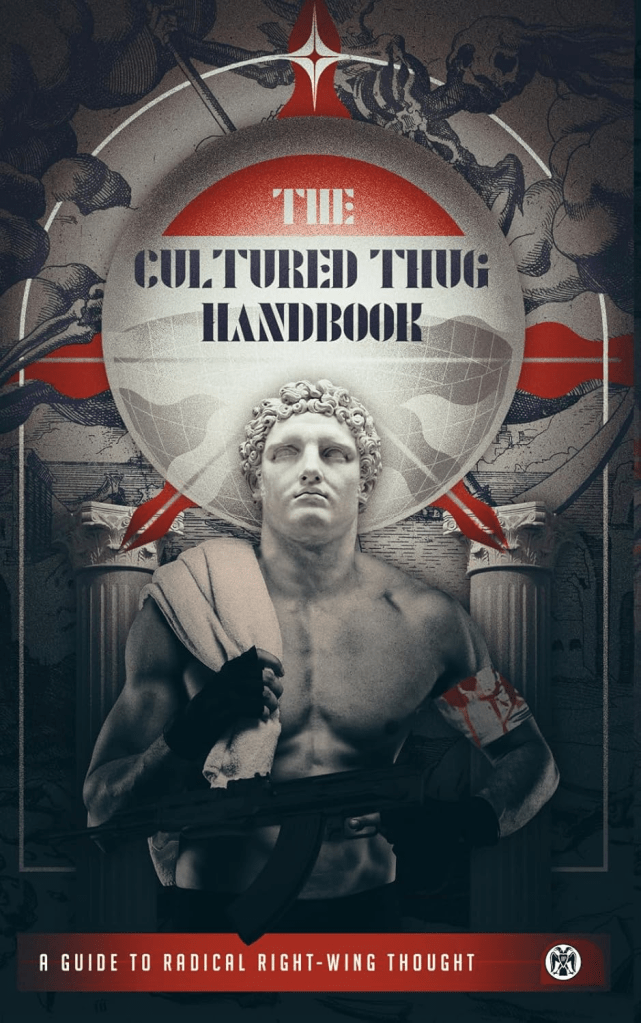
Ten years ago, a new set of terms entered our everyday discourse: “intersectionality,” “cultural hegemony,” “cisgender,” “heterosexism,” “white privilege,” “ableism.” These words and phrases were part of a Neo-Marxist worldview that emerged from the political left. Today, something similar seems to be happening on the political right. Words and phrases like “the friend-enemy distinction,” “redpill,” “cuckservative,” “anarcho-tyranny,” and “the Cathedral” are leaking out of online subculture and making their way into the mainstream. Can we likewise understand this vocabulary in terms of a comprehensive worldview?
Mike Maxwell’s The Cultured Thug Handbook suggests that the answer is: Yes.
Maxwell is the owner of Imperium Press, an Australia-based publisher which calls itself the “classics department of the Dissident Right.” His book is a Rosetta Stone for those trying to decipher radical right language and idioms. Its forty-four chapters (with an average length of 9 pages) cover topics like “The Deep State,” “The Cathedral,” “What Liberalism Is,” “Bioleninism,” “Accelerationism,” “Anarcho-Tyranny,” “Physiognomy,” “Nietzsche – Master and Slave Morality,” “Spengler – Cyclical History,” “Schmitt – Friend-Enemy Distinction,” and “Evola – Ride the Tiger.”
What makes the book particularly interesting, especially for Christians, is that these eclectic ideas and thinkers are presented in terms of a coherent picture of reality, what Imperium Press calls “the Aryan Worldview.” According to Maxwell, the illiberal ideas that we slander as “regressive” or “fascist” were simply common sense for the vast majority of people throughout history: “You have been gaslit into thinking that these words—Aryan, right-wing, reactionary—are evil and abhorrent. For the first 99.98% of history people like us were the good guys, and in the near future and forever more we will again be on the `right side of history'” (Imperium Press, 2023). On his view, liberalism is a monstrous aberration (“the most extreme ideology that has ever existed in the history of the world,” 9), teetering under the weight of its manifold absurdities and on the verge of complete collapse.
Core Ideas of the Radical Right: Hierarchy, Absolutism, and Tradition
Hierarchy
If one word captures the fundamental governing principle of the Dissident Right, it is “Hierarchy.” The existence of, maintenance of, and perpetuation of hierarchy is a central concern in nearly every chapter of Maxwell’s book. Put simply, Maxwell believes that there exists a natural human hierarchy and that the structure of society should reflect that fact:
The oldest, strongest, and most consequential things–patriarchy, ethnocentrism, traditional sexual roles, the family, authoritarianism, and above all, hierarchy–must be deferred to. Not because they’re good but because they’re the source of all good, because without them we don’t even have a society in the first place–because a thing can’t be good unless it first is. (65)
Because of his exaltation of hierarchy, Maxwell despises “universalism,” the attempt to prioritize human commonalities over human differences. He writes:
The right loves hierarchy and the very notion of hierarchy is particularistic — the ultimate universalism is equality… when the liberal demands equal rights, he’s saying ‘there’s some substantial sense in which we’re all the same’.”… ‘We are all X’ is either the highest value or not. If it is, then particularized identities and human difference–including difference in quality and rank–are subordinate to it. These are left-wing values. If ‘we are all X’ is not the highest value, then universal identity and human equality are subordinate, and we have right-wing values. (83-84)
Absolutism
A second pillar of Maxwell’s ideology is the importance of power. Great Men, at the top of the natural hierarchy, already possess superior will, intellect, and ability. But an ideal society would also grant them near-absolute political power rather than attempting to restrain it. Hence Maxwell’s enthusiasm for “absolutism” and his rejection of (classically) liberal concepts like limited government, checks and balances, or the rule of law:
“Far from being an outdated model of government, absolutism is how all governments work by necessity, and have done from the beginning of time to now. The basic idea behind absolutism is that a) sovereignty is indivisible, and b) the sovereign is necessarily above the law” (99)
Absolutism simply demands that the head man –the sovereign– have full authority in his local context (146)
Even more controversially, Maxwell endorses the idea that power defines morality:
The idea that all morality ultimately cashes out to some kind of power is what we call might is right. (333)
might is right is probably the most controversial [idea discussed in this book]. It seems inhuman, ugly, and corrosive to any system of morals. And yet, if we were honest with ourselves, we should see that every major moral system implicitly rests on it–it’s the final place of refuge for any worldview, and sooner or later, they all fly to it (337-338)
“There is no ius gentium [law of nations], no right for all men (339)
Tradition
Finally, Maxwell justifies hierarchy and absolutism on the basis of tradition. Tradition, Maxwell maintains, is not an arbitrary set of customs, but a condensation of millennia of human wisdom.
Tradition –like great art– is not stagnation, but freedom within constraint. The liberal comes across Chesterton’s fence and asks ‘why is this here I don’t know’ and rips it down, then is gored by an angry bull. ‘I don’t see why not’ is the worst reason to do anything because the dumber you are, the more often it applies. (p45)
Similarly, Maxwell believes that “natural law” teaches us how societies should function. Here, “natural law” does not refer to the Christian belief that God’s moral law is reflected in the universe He created. Instead, it refers to “what happens naturally”: “Natural law is just the way things work, no more and no less” (313). In this way, “natural law” is like the law of gravity or the law of entropy; it can’t be avoided. We can determine natural law not by discerning God’s design but rather by observing “the slow organic growth of traditional folkways… where the natural law is the result of natural selection working over immense spans of time on human institutions” (315).
The widespread historical existence of an institution or practice is, on Maxwell’s view, grounds to think that it conforms to “natural law” and is therefore justified. The liberal reformer who wants to reorder society should be summarily ignored in the same way that we ignore the man who wants us to outlaw food and to eat bricks and scorpions instead.
Secular critique
For many people, especially disaffected young White men, the Dissident Right can seem exhilarating. Maxwell delights in speaking “forbidden truths” about race and gender. He revels in mocking the “rootless cosmopolitan bugman” (4), the “stupid, b*tchy, fat women” (110), “the six-legged polysexual dwarf…that nature abhors and eliminates at the earliest opportunity” (118), etc. He extols the power and virility of the straight White males who built civilization. If you’ve been told all your life that your race and gender make you a racist, sexist, oppressor who needs to “sit down and shut up,” Maxwell presents himself as an ally.
That said, Maxwell also presents himself as an intellectual. Throughout the book, he makes hundreds of forceful claims, many of which reference the dozens of endnotes that close out every chapter. Consequently, readers could easily come away with the impression that Maxwell is relaying uncomfortable but undeniable empirical facts that have been suppressed by the “woke” “Cathedral” and the “bioleninist” “Deep State.”
Unfortunately, they would be mistaken.
Consider two obvious examples:
On p. 83 Maxwell cites a highly-publicized Nature paper to argue that:
“liberals’ horizon of care tends to centre around ‘all living things in the universe including plants and trees’. The liberal gives as much moral consideration to a pine cone as to his own mother–this is what happens when you take universalism seriously enough.”
This interpretation, and the heat map that often accompanied it, was extremely popular among Dissident Right accounts on social media. But it simply isn’t true.

These data were generated by asking conservatives and liberals to specify the “extent of [their] moral circles.” The survey did not ask people which entities they value more; it only asked about which entities they value at all. To put it another way, if you believe that torturing birds is wrong, your answer would have placed you closer to a “liberal” than to a “conservative.” In short, Maxwell either badly misread the study or mistook Internet memes about its results for the actual results.
Another example of factual errors comes in Maxwell’s statement that “As of 2022, about 76% of Americans were white[9], but as of that same year, only 41% of Ivy League students were white[10]; this disparity is mainly driven by diversity quotas[11]” (305). He cites three different sources to substantiate this claim, none of which support it.
First, the “76%” figure cited from his reference 9 counts Hispanics as “White”; in fact, the very same source states that only 59.3% of Americans were non-Hispanic White. Second, the racial disparity among Ivy League students can be entirely accounted for by the fact that 27% of Ivy League students are Asian — as reported in the same article Maxwell cites in his reference 10. Finally, his reference 11 is an article about university faculty hiring policies, not about student admissions in the Ivy League or elsewhere.
Of course, it’s possible to critique liberal universalism or racial discrimination in academia independent of Maxwell’s empirical claims. But such blunders suggest that readers should take his statements, even those which are heavily footnoted, with a grain of salt.
Apart from empirical problems, there are serious philosophical concerns with Maxwell’s project. I’ll name just one.
Maxwell explicitly rejects the correspondence theory of truth (i.e. “truth corresponds to reality”) in favor of a pragmatic theory of truth (i.e. “truth is what works”). He writes:
What’s been around forever at the very least works, and that is the final measure of truth. This is what’s called the pragmatic theory of truth. A thing is true because of its consequences, whether they be practical consequences, consequences for other beliefs, or logical consequences–all other theories of truth are special cases of this one. (50)
Pragmatic truth (‘what’s true is what’s good to believe’) agrees with our best science: a recent study found that ‘our perceptual systems have evolved to provide a species-specific interface to guide adaptive behavior, and not to provide a veridical representation of objective reality. (51)
“What’s true is what’s good to believe” (52)
The irony of Maxwell embracing a theory of truth most associated with radical 20th-century postmodern philosophers like Richard Rorty is stunning (thought not entirely surprising, given then Dissident Right’s sympathies with critical theory and Neo-Marxism). After all, the common-sense correspondence theory of truth has “worked” for civilizations going all the way back to ancient Greece, and it’s the basis of all modern science. On what grounds should we cast it aside? What happened to the beauty of tradition and Chesterton’s fence?
Even more brutally, Maxwell has to reckon with the fact that liberalism conquered the entire Western world in the span of a few centuries. When Maxwell asks “if liberalism is so bad, how did it win?” (322) he’s tacitly admitting that it did win. Bigly. Indeed, all of his complaints about blue-haired HR ladies and the surveillance state merely underline the comprehensiveness of liberalism’s victory. Maxwell appeals to Nietzsche to argue that liberalism won by tricking the strong and powerful into accepting slave morality (more later). But on what grounds can he oppose that deceit? Liberalism “worked,” therefore, it’s true, right?
He faces exactly the same pragmatic problem when he attempts to explain how tyrants… er… Great Men can claim the “Mandate of Heaven” only so long as they continue to hold power (377). As long as Vlad the Impaler occupies the royal palace, he must have the favor of the gods. The peasants might hope that Vlad will eventually be deposed, showing that the gods never supported him. But they can’t know whether that’s true while he’s still in power.
In the same way, it’s all very well to insist that liberalism is crumbling and that it will soon be replaced by a Fascist State (or a Glorious Communist Republic or the United Federation of Planets). But there’s the rub: you can’t know whether the Mandate of Heaven has been repealed until after the fact. In the meantime, the dissident has no basis to criticize the conqueror. As long as liberalism continues to hold power, it is “true” and rules by the divine will of the beneficent gods of the Deep State.
You can’t have it both ways. You don’t get to cosplay as the Nietzschean supervillain uberchad who thinks that “winning” is the final justification for any philosophy and then cry “it’s not fair” when the “low-IQ metrosexual bugmen” keep winning.
Christian Critique
While the influence of the Dissident Right on evangelicals is small, it is growing. Many evangelicals reject the insanity of the Great Awokening and are therefore reconsidering the (classically) liberal political assumptions made by their parents and grandparents.
Here it’s important to draw a distinction between postliberalism and the Dissident Right. Christians should feel entirely comfortable asking “postliberal” questions like: does a “neutral public square” really exist? Can laws exist without substantial moral consensus? What is the relationship between the church and the state? etc.
But we should not feel comfortable with seeking answers to these questions from the Dissident Right, built as it is on the foundation of explicitly and often virulently anti-Christian figures and ideas.
Maxwell’s invocation of Nietzsche’s master-slave morality alone should be a deal-breaker for Christians. Listen to Maxwell himself describe the origins of “morality” and concepts like “good” and “evil”:
“Slave moralists can’t oppose the master directly, with force–they’re inherently inferior. So they develop ‘Morality’…. Morality with a capital-M looks universalist–it’s everyone under the same rubric, all souls equal before some ultimate moral force. It looks pacifist–it hates violence and strength, celebrates meekness. It looks anti-natural–nature is icky, evil, or secondary… [Morality] matches up hip and thigh with liberalism–we have here a universalist morality that can leave no stone unturned” (325-326)
Maxwell is eager to enlist Christians in his Nietzschean vision, assuring readers that while “Nietzsche [aimed] his critique of slave morality at Christianity…it makes an even better critique of liberalism” (326). But universal acids are universal acids. A Christian who rejects universal morality to “own the libs” is burning down his own house to spite an unwanted houseguest.
Indeed, for all his bluster, Maxwell seems curiously hesitant to attack Christianity. For example, he repeatedly criticizes Islam for being a vector of universalism. He rightly recognizes that “Islam is a propositional identity” (382) because Muslims call people to abandon the traditions of their ancestors. They are Muslim first, before they are Arab, or African, or Asian. This higher allegiance will indeed erode the importance of the tribe, the clan, the ethnicity: “Islam can’t be both universal and tribal, and past a certain point its effect has always been to collapse [group feeling and solidarity]” (275).
Yet precisely the same critique can be leveled against Christianity. Christianity also calls us to abandon our ancestors’ gods and to test all of our received customs, traditions, practices, and values against God’s universal moral standards. It calls us to place our deepest identity in Christ, an identity that transcends race, class, gender, ethnicity, ancestry, social status all the other markers that are so dear to both Woke Left and the Dissident Right.
It’s unclear why Maxwell pulls his punches when it comes to Christianity, which displaced the pagan religions of his own Aryan ancestors. Regardless, Maxwell’s reasoning admits of no exceptions. If universalism is bad and subversive, then Christianity is bad and subversive. It is no accident that many important Dissident Right figures were openly pagan or anti-Christian: Nietzsche, Evola, de Benoist.
If you reject universalism, worship power as the source of morality, despise the weak, and embrace a postmodern, pragmatic theory of truth, you can still be religious, but you certainly can’t be a Christian.
Conclusions
Evangelicals who are sympathetic to the Dissident Right will insist that they can adopt the Dissident Right’s critiques of liberalism without falling into its errors.
I’d offer two responses.
First, if the Great Awokening taught us anything, it’s that ideologies and social groups are seductive. How many times were we told “I’m not embracing critical race theory wholesale; I just think it sheds light on white privilege and systemic oppression”?
I personally lost friends to wokeness. At first, they distanced themselves from the more grossly unbiblical ideas within the social justice movement. But gradually, these ideas infected their theology. They began to feel more at home among “social justice advocates” than they felt among conservative Christians.
I’m seeing the same phenomenon play out today on the Right. At first, you cringe at the racists, misogynists, and anti-Semites in your group chat. Then you become accustomed to them. And then, you decide that maybe they have a point.
Second, the same arguments the Dissident Right deploys against liberalism can be deployed against Christianity. Radical right figures like Alain de Benoist embraced paganism precisely because he believed that modern liberalism’s beliefs about human equality, human rights, and universal values were derived from Christianity.
To put it another way, as a Christian, you will never win the “most based guy in the room” game. Sure, you can nod along as the Nietzschean complains that the West is “weak” and “effeminate” and that men are being “emasculated” and “longhoused” by “the Cathedral.” But when he starts arguing that monogamy is for losers and betas, you’ll find yourself called a “feminized simp” for defending biblical sexual ethics.
When he starts railing against the “DEI Regime,” “woke nonsense” and “anti-White race hatred,” you can puff out your chest. But when he starts arguing that interracial marriage is dysgenic and that abortion is good because it disproportionately kills Black babies, you’ll discover that you’re actually a “woke lib race traitor” who promotes “White genocide” because you affirm that interracial marriage is, in fact, morally permissible and that all people are made in God’s image.
Such conflicts are inevitable. From Maxwell’s admiration for Vladimir Putin (12) and Muammar Gaddafi (265), to his valorization of “blood and soil” (205), to his framing of World War II as an attempt by the Nazis to prevent “rule by merchant” (348), to his reliance on the work of Nazi jurist Carl Schmitt (377-387), to the utter contempt with which he regards “freaks and ghouls,” “stupid ugly harpies,” and “midwits” (110-111), there is no question that he and Christians are living in different moral universes and traveling in different directions.
Dr. Pat Sawyer and I wrote our new book Post Woke: Asserting a Biblical Vision of Race, Gender, and Sexuality in part because we recognized that being “anti-woke” is different than being biblical. You can despise critical race theory without having a biblical understanding of ethnicity. You can reject feminism without embracing a biblical vision of gender. You can sneer at queer theory without submitting to God’s design for sex. Just as “social justice evangelicals” had to recognize and repudiate the Neo-Marxist ideology behind contemporary progressivism, “dissident evangelicals” will have to recognize and repudiate the will-to-power ideology behind the Dissident Right.
What hath Nietzsche to do with Jerusalem?
Related resource:

